
Summary of the Article
- Faire: appears in weather, activities, and everyday tasks; the trap is vous faites, not vous faisez.
- Aller: builds the futur proche (je vais partir) and takes être in the passé composé; je alle is a classic error.
- Venir: takes être in the passé composé with agreement (je suis venu(e)) and venir de means "just did something."
- Pouvoir, vouloir, devoir, prendre, dire, savoir: the supporting set that carries opinions, plans, and narrations.
- At NCLC 7, graders judge whether you control these verbs in the right tense, so drill forms, not just meanings.
You do not need hundreds of verbs for the exam. You need roughly ten irregular verbs that show up in almost every sentence you will write or say, plus the handful of tenses those verbs appear in. Most candidates spread their French conjugation practice thin; the ones who reach NCLC 7 drill a short list until it is automatic.
Why a Short Verb List Beats a Long One
This matters because the exam rewards control, not size. A B2-level sentence full of rare verbs but built on wrong conjugations loses grammar points. A simple sentence with flawless forms of faire, aller, and venir reads as controlled French.
The regular side of French is manageable: -ER verbs follow one pattern you can learn once (we have a full guide to French -ER verbs for TEF Canada). Irregular verbs are the opposite. They follow no pattern you can derive, so they must be memorized individually. That is why the short list below is ordered by how much work each verb does in exam tasks, not by alphabet.
Faire: The Verb of Activities and Weather
| Person | Faire (to do, make) |
|---|---|
| je | fais |
| tu | fais |
| il / elle / on | fait |
| nous | faisons |
| vous | faites |
| ils / elles | font |
Faire is everywhere because French uses it for chores, sports, and weather:
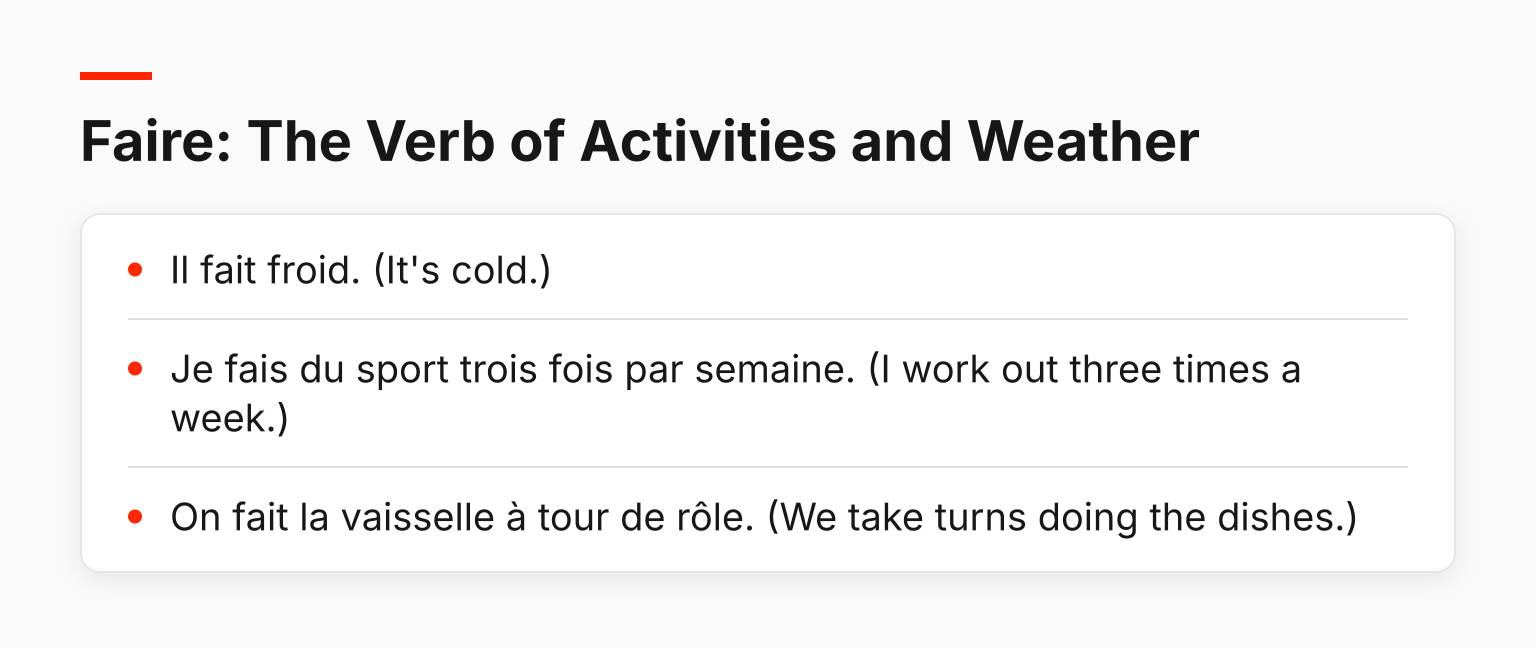
- Il fait froid. (It's cold.)
- Je fais du sport trois fois par semaine. (I work out three times a week.)
- On fait la vaisselle à tour de rôle. (We take turns doing the dishes.)
In the passé composé, faire takes avoir and an irregular participle: j'ai fait, nous avons fait. J'ai fait mes devoirs hier. In the futur proche: je vais faire mes courses demain.
The trap is the vous form. Nearly every candidate writes vous faisez at least once. It is vous faites. Write that form ten times by hand and you will never lose the point again.
Aller: The Verb That Builds Your Future Tense
| Person | Aller (to go) |
|---|---|
| je | vais |
| tu | vas |
| il / elle / on | va |
| nous | allons |
| vous | allez |
| ils / elles | vont |
Aller earns its place at the top for one reason: the futur proche. To talk about your plans in the speaking section or writing task 1, you use aller + infinitive, with no preposition between them:
- Je vais présenter mes idées. (I'm going to present my ideas.)
- Nous allons déménager l'année prochaine. (We're going to move next year.)
The classic error here is je alle or je alle à l'école. There is no alle anywhere in the conjugation; the first person is je vais.
In the passé composé, aller takes être: je suis allé(e), nous sommes allé(e)s. (More on the être auxiliary in the venir section.) And note the daily-life usefulness: Ça va? / Ça va bien, merci, and on va voir (we'll see) all come from this verb.
Venir: The Verb of Origins and Recent Past
| Person | Venir (to come) |
|---|---|
| je | viens |
| tu | viens |
| il / elle / on | vient |
| nous | venons |
| vous | venez |
| ils / elles | viennent |
Venir does two exam-critical jobs:
- Origins and provenance. Je viens du Brésil (I come from Brazil) is in almost every speaking introduction. Watch the preposition: venir de for feminine countries and cities (de France, de Montréal), venir du for masculine countries (du Mexique), venir des for plurals.
- The recent past. Venir de + infinitive means you just did something: Je viens de finir mes études (I have just finished my studies). This one structure instantly adds a tense variety graders look for.
Like aller, venir takes être in the passé composé, and the participle must agree with the subject: je suis venu(e), elle est venue, ils sont venus, elles sont venues. A group of movement verbs (aller, venir, partir, arriver, rester, and others) works this way, and the passé composé with être explainer from UT Austin covers the full group and the agreement rule if you want the details.
One caution: you already know venir de as "just did" and venir de as "come from." Context separates them; je viens de Paris and je viens de partir are both correct.
The Supporting Set: Six More Verbs That Carry Exam Tasks
- Pouvoir (je peux, tu peux, il peut, nous pouvons, vous pouvez, ils peuvent): your politeness and possibility verb. Je peux poser une question? Past participle: pu.
- Vouloir (je veux, tu veux, il veut, nous voulons, vous voulez, ils veulent): expressing wishes and requests. Participle: voulu. In conditionnel: je voudrais is the polite "I would like."
- Devoir (je dois, tu dois, il doit, nous devons, vous devez, ils doivent): obligation, essential for arguing a position. Participle: dû.
- Prendre (je prends, tu prends, il prend, nous prenons, vous prenez, ils prennent): daily-life tasks like prendre le bus, prendre un rendez-vous. Note the doubled n in ils prennent. Participle: pris.
- Dire (je dis, tu dis, il dit, nous disons, vous dites, ils disent): reporting opinions, il dit que.... Participle: dit.
- Savoir (je sais, tu sais, il sait, nous savons, vous savez, ils savent): facts and knowledge, and the difference between savoir and connaître is a favorite nuance question. Participle: su.
Two single-verb auxiliaries sit underneath all of this. Être and avoir appear in every passé composé you will ever form, so if they are not yet automatic, go deeper with our guides to être conjugation and avoir conjugation before anything else.
The Tenses That Actually Get Graded at NCLC 7
- Présent. The default tense of every task. All ten verbs, all six persons, automatic.
- Passé composé vs imparfait. Narrative tasks ("describe your last holiday") test whether you can pick the right past: j'ai visité (a completed event) vs il faisait beau (a background state). This pairing is where most grammar points are won or lost.
- Futur proche. Plans and intentions: je vais + infinitive. Cheap to learn, high value.
- Conditionnel. Politeness and hypotheticals: je voudrais, on pourrait. Speaking sections reward this heavily.
Automate the forms above in each tense rather than studying tense theory in the abstract. A verb form you can produce without thinking is worth more than one you can recognize on a chart.
The Four Errors That Cost Points in Expression Écrite
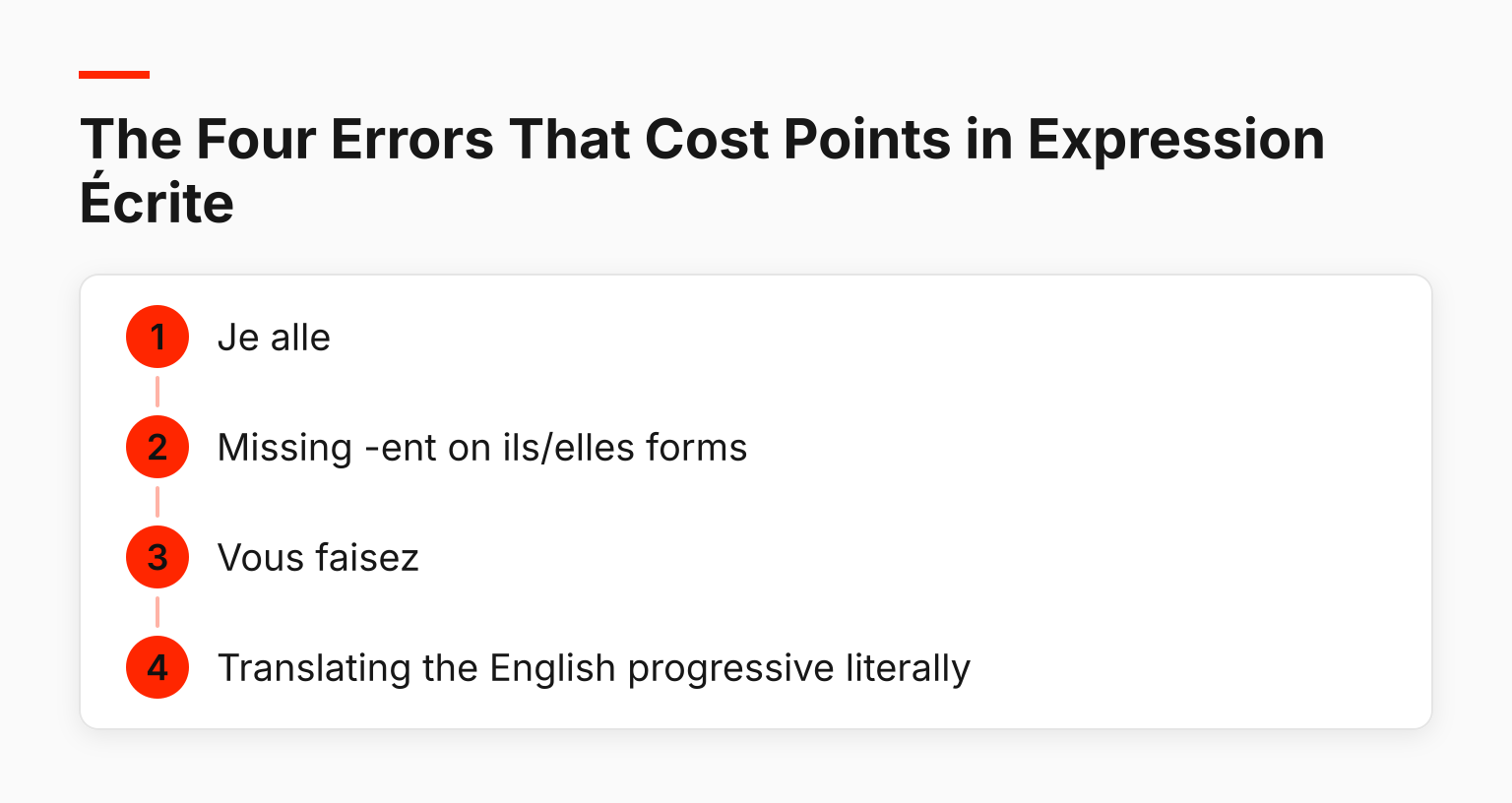
- Je alle (instead of je vais). All forms of aller are irregular; memorize them as a unit.
- Missing -ent on ils/elles forms. Ils viennent, ils font, ils prennent, ils savent. Dropping the -ent in writing is a visible spelling error even though it is silent in speech.
- Vous faisez (instead of vous faites). The most seductive error in French because faisez looks regular.
- Translating the English progressive literally. "I am doing" is je fais, not je suis faisant. French present tense covers both "I do" and "I am doing."
Correcting just these four habits protects more grammar points than learning ten new verbs.
How Verb Control Shows Up in Each Exam Section
For writing specifically, our TEF Canada writing cheat sheet shows how these verb patterns fit into a task-by-task framework.
A Short Drill Routine for These Verbs
- Blank-table recall (3 minutes). Write the present tense of one verb from memory, no chart. Check, mark errors, repeat tomorrow with a different verb.
- Sentence production (5 minutes). Say or write one sentence per verb per day in a real context: a plan (je vais...), a recent past (je viens de...), an activity (je fais du...), an opinion (je pense qu'il faut...).
- Mixed-tense rewriting (5 minutes). Take a five-sentence paragraph in the present and rewrite it in the past (passé composé where appropriate), then in the future. This trains the tense-switching the exam tests.
- Error log (2 minutes). Keep a running list of your own slips, especially the four errors above. Re-test each one weekly until it stops appearing.
Consistency beats volume here. Ten verbs drilled daily for three weeks will feel automatic; fifty verbs crammed once will not.