
Summary of the Article
- Master chart first: présent, imparfait, futur simple, passé composé, conditionnel présent. These cover most of what you will actually write and say.
- Avoir is an auxiliary: most past-tense sentences in Section A writing are built with it (j'ai eu, il avait eu).
- Expressions carry marks: avoir besoin de, avoir envie de, avoir raison, avoir l'air show up in both speaking and writing tasks.
- Watch the classic traps: j'ai eu vs il y a, wrong auxiliary choice, and missing past-participle agreement.
If you want the same treatment for the other essential verb, see our guide to être conjugation for TEF and TCF Canada, including how to choose between the two auxiliaries.
Why Avoir Matters More Than "To Have"
First, it is a full verb with its own meanings: age (j'ai 30 ans, I am 30), hunger and thirst (j'ai faim, j'ai soif), and dozens of fixed expressions.
Second, and more important for the exams, avoir is the auxiliary (helping verb) that builds compound tenses for most French verbs. Passé composé, plus-que-parfait, conditionnel passé, futur antérieur and past subjunctive all use avoir or être plus a past participle. Since most verbs take avoir, almost every past-tense sentence you write in the exam runs through it. Get avoir wrong and you lose grammar marks across the whole text, not just one word.
That is why the TEF Canada candidate manual lists Section A of the writing test as "raconter une histoire en utilisant les temps du passé" (tell a story using past tenses), with grammar counted separately in the grading. Past tenses built on avoir are not optional decoration; they are the task.
The Master Chart: Avoir in the Five Tenses You Need
| Person | Présent | Imparfait | Futur simple | Passé composé | Conditionnel présent |
|---|---|---|---|---|---|
| je | j'ai | j'avais | j'aurai | j'ai eu | j'aurais |
| tu | tu as | tu avais | tu auras | tu as eu | tu aurais |
| il / elle | il a | il avait | il aura | il a eu | il aurait |
| nous | nous avons | nous avions | nous aurons | nous avons eu | nous aurions |
| vous | vous avez | vous aviez | vous aurez | vous avez eu | vous auriez |
| ils / elles | ils ont | ils avaient | ils auront | ils ont eu | ils auraient |
Notice the pattern in the future and conditional stems: both start with aur-. The passé composé uses the present of avoir plus eu, the past participle. If you know the present, you can build the passé composé of any verb with avoir.
For the full set of forms, including literary tenses you will not need on the exam, a standard reference like Lawless French's avoir verb table or Le Conjugueur is reliable. For hearing the pronunciation out loud, this video lesson on avoir pronunciation and conjugations walks through the main forms.
Passé Composé with Avoir: Formation and Agreement
present tense of avoir + past participle eu
- J'ai eu une réponse hier. (I got an answer yesterday.)
- Elle a eu un accident sur la route. (She had an accident on the road.)
- Nous avons eu de la chance. (We got lucky.)
Two rules cause most of the trouble.
1. Agreement with a direct object placed before the verb. With avoir, the past participle does not agree with the subject. It agrees only with a direct object that comes before the verb, usually a preceding direct object pronoun.
- Il a eu les documents. (no agreement: les comes after)
- Il les a eus. (agreement: the masculine plural object les comes before)
- Elle a eu la nouvelle. → Elle l'a eue. (feminine agreement with la)
In exam writing, most avoir passé composé sentences have no preceding object, so the participle stays eu with no ending. If you add an ending, ask yourself what it agrees with.
2. Choosing avoir vs être. Only a small set of verbs (and all reflexive verbs) take être in the passé composé: aller, venir, arriver, partir, sortir, entrer, naître, mourir and their relatives. Everything else takes avoir. Writing il a allé instead of il est allé is a classic error. If you keep mixing these up, work through the auxiliary-choice section in the être conjugation guide.
Imparfait of Avoir and Plus-Que-Parfait
- Quand j'étais étudiant, j'avais peu d'argent. (When I was a student, I had little money.)
- La ville avait un problème de transport depuis des années. (The city had had a transport problem for years.)
Imparfait and passé composé work as a pair in Section A: imparfait sets the scene, passé composé moves events forward. Preparation sites for the TEF writing section make exactly this point: imparfait for the setting and lasting situations, passé composé for the punctual actions that advance the story.
From the imparfait you build the plus-que-parfait (pluperfect), the "past before the past":
imparfait of avoir + eu
- Il avait eu son permis avant de venir au Canada. (He had gotten his licence before coming to Canada.)
- Elle n'avait jamais eu de problème avec la loi. (She had never had a problem with the law.)
The plus-que-parfait pairs with the conditionnel passé in si-sentences: Si j'avais eu plus de temps, j'aurais révisé davantage. (If I had had more time, I would have revised more.) This structure is a strong marker in TCF Canada's higher levels because it shows you can handle hypothetical reasoning about the past. Save the simple version in your head: si + plus-que-parfait, then conditionnel passé.
Futur Simple and Futur Proche for Plans
Futur simple (one word, stem aur-):
- J'aurai les résultats la semaine prochaine. (I will have the results next week.)
- Vous aurez besoin d'un traducteur assermenté. (You will need a sworn translator.)
Futur proche (aller + infinitive), which is easier and very natural in speaking:
- Je vais avoir une réunion avec mon conseiller. (I am going to have a meeting with my advisor.)
In exam tasks about plans (moving, studying, working), futur proche keeps you fluent; futur simple, used accurately, adds range. Mix both.
Conditionnel Présent and Passé: The Argumentation Tenses
Conditionnel présent (stem aur- + imparfait endings) for polite requests, suggestions and hypotheticals:
- Je voudrais savoir si vous auriez des informations sur ce programme. (I would like to know whether you would have information on this program.)
- Ce projet aurait des avantages économiques. (This project would have economic advantages.)
Conditionnel passé (conditionnel présent of avoir + eu) for claims about the unrealized past:
- Si le gouvernement avait agi plus tôt, la situation aurait eu des conséquences moins graves. (If the government had acted earlier, the situation would have had less serious consequences.)
In argumentation, conditionnel lets you present an opinion with nuance (il aurait été préférable de...) instead of blunt assertions, which is exactly the register the writing tasks reward. A text that controls subordinate clauses and the conditional reads a level above one that is merely error-free.
Subjonctif with Avoir: Que J'aie
It appears in argumentation after expressions of necessity, doubt and emotion:
- Il est essentiel que nous ayons plus de logements. (It is essential that we have more housing.)
- Je ne pense pas qu'il ait raison. (I don't think he is right.)
You do not need it in every sentence. Dropping in one or two correct subjunctives in a Section B argument is enough to show range.
High-Frequency Avoir Expressions for the Exams
| Expression | Meaning | Exam-style example |
|---|---|---|
| avoir besoin de | to need | J'ai besoin de plus de temps pour préparer l'examen. |
| avoir envie de | to want / feel like | Il avait envie de changer de carrière. |
| avoir raison / tort | to be right / wrong | Tu as raison, le loyer a augmenté. |
| avoir l'air | to seem | Cette solution a l'air efficace. |
| avoir du mal à | to have difficulty | J'ai du mal à comprendre les accents québécois. |
| avoir peur de | to be afraid of | Elle a peur d'échouer à la section orale. |
| avoir de la chance | to be lucky | Nous avons eu de la chance avec la météo. |
| avoir honte de | to be ashamed of | Il avait honte de son accent. |
| avoir l'intention de | to intend to | J'ai l'intention de m'installer à Montréal. |
| avoir confiance en | to trust / have confidence in | Les citoyens n'ont plus confiance en ces institutions. |
Two practical notes:
- Expressions give you natural filler with real content in speaking. "J'ai du mal à..." and "J'ai l'impression que..." buy thinking time while sounding advanced.
- In argumentation, avoir raison/tort, avoir l'air and avoir confiance en let you discuss opinions without always repeating penser que.
For how these fit into a full speaking response, see the TEF Canada speaking cheat sheet with Section A and B templates.
A Short Exam-Style Narrative Using All the Past Tenses
Ce matin-là, il faisait froid et la foule attendait devant la gare. Soudain, un jeune homme a couru vers le quai. Il avait eu un entretien d'embauche prévu à 9 heures, mais son train était en retard. Une passante a remarqué son anxiété et lui a proposé de l'accompagner en voiture. Finalement, il est arrivé à temps et il a eu le poste.
Read it aloud and you can feel the rhythm: imparfait paints, passé composé pushes, plus-que-parfait explains. That rhythm, more than any single conjugation, is what graders mean by control of past tenses. The TEF Canada writing cheat sheet builds a full framework around this.
Five Mistakes That Cost Points
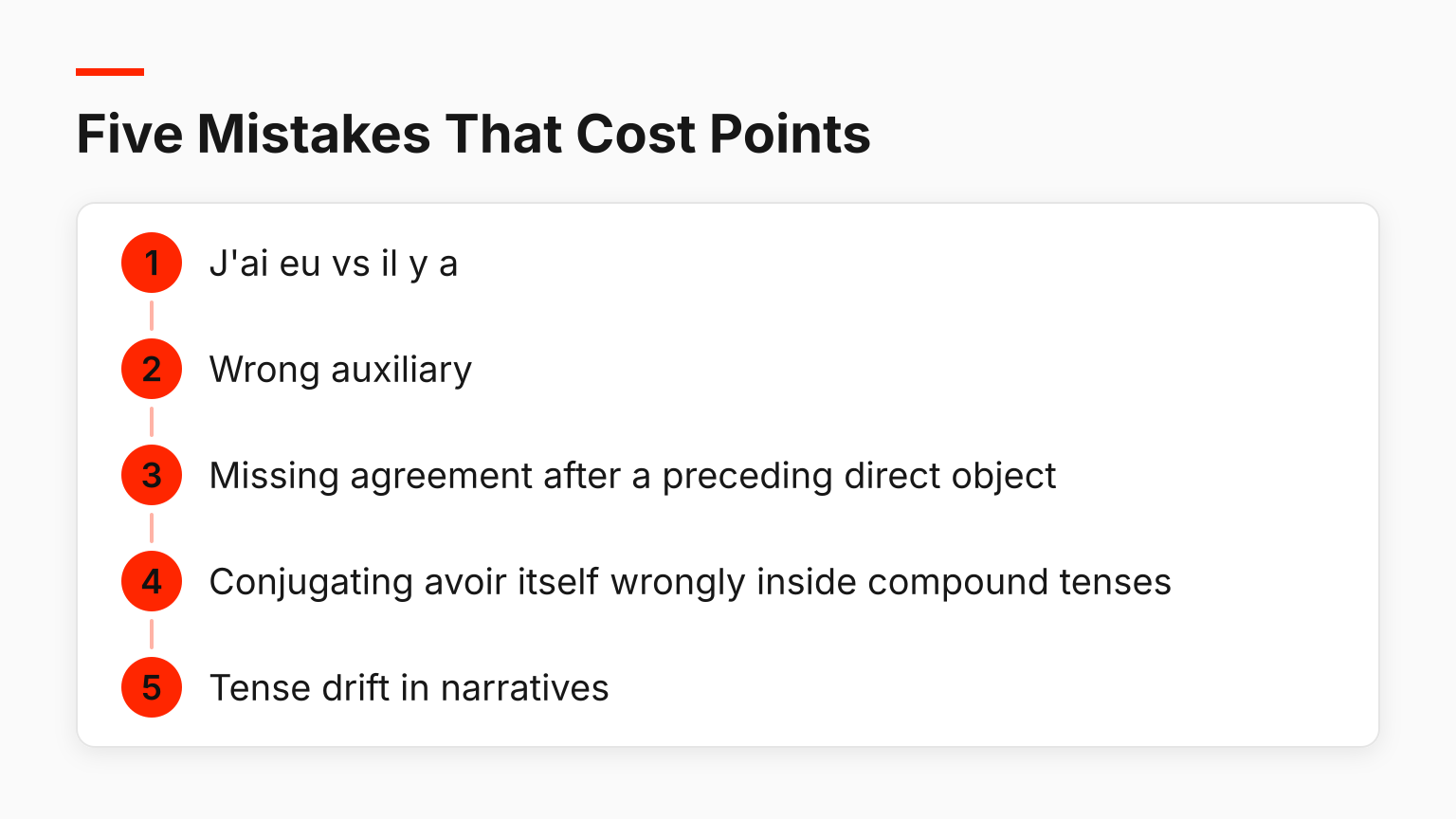
- J'ai eu vs il y a. Il y a means "there is / there are" (or "ago": il y a deux ans). It is not a conjugation of avoir with a subject. Writing "J'ai eu un problème" (I had a problem) is fine; "Il a un problème" and "Il y a un problème" mean different things. Mixing them up confuses readers instantly.
- Wrong auxiliary. J'ai allé, j'ai parti, j'ai resté are wrong. Those movement verbs take être. When in doubt about a specific verb, check it; the practical être and avoir guide covers the two-verb split with examples.
- Missing agreement after a preceding direct object. Les photos que j'ai prises, not que j'ai pris. With avoir, agreement exists but only in this specific case.
- Conjugating avoir itself wrongly inside compound tenses. Il a eu, not il a eu eu or il eu. The auxiliary carries the tense; the past participle eu stays eu unless a preceding direct object forces agreement (see mistake 3 above).
- Tense drift in narratives. Starting in passé composé and sliding into present tense. Pick your narrative frame and hold it across the whole text; graders check tense consistency across paragraphs, not just sentences.
How to Lock These Forms In Before Exam Day
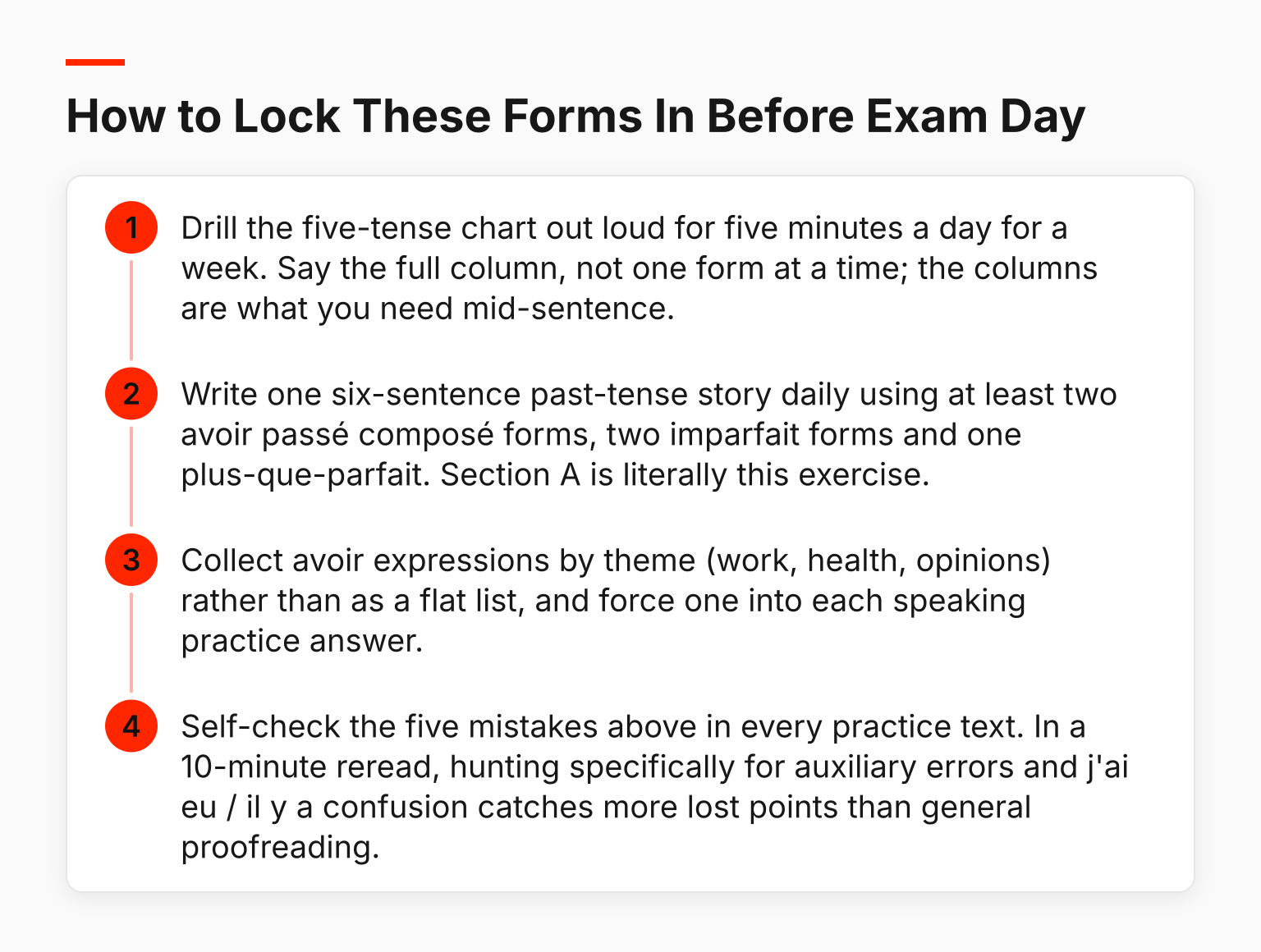
- Drill the five-tense chart out loud for five minutes a day for a week. Say the full column, not one form at a time; the columns are what you need mid-sentence.
- Write one six-sentence past-tense story daily using at least two avoir passé composé forms, two imparfait forms and one plus-que-parfait. Section A is literally this exercise.
- Collect avoir expressions by theme (work, health, opinions) rather than as a flat list, and force one into each speaking practice answer.
- Self-check the five mistakes above in every practice text. In a 10-minute reread, hunting specifically for auxiliary errors and j'ai eu / il y a confusion catches more lost points than general proofreading.
If you want structured practice with feedback rather than solo drilling, you can sign up to start free practice with 1,000 credits on CanadaFrenchPath, with section drills, mock exams and AI grading across all four skills, built around the NCLC 7+ goal.