
Summary of the Article
-ER verbs are the largest group of French verbs. Learn one conjugation pattern and you can handle most everyday verbs, including the ones you will need in TEF Canada and TCF Canada writing and speaking. According to Lingvist, about 90% of French verbs end in -er, so this one pattern covers most of what you will actually say.
- The pattern: drop -er and add -e, -es, -e, -ons, -ez, -ent. Example: je parle, tu parles, il parle, nous parlons, vous parlez, ils parlent.
- The endings are mostly silent: je parle, tu parles, il parle, and ils parlent all sound the same in speech. This is a common listening trap on the exam.
- A few verbs change spelling: appeler, jeter, acheter, manger, commencer, nettoyer. Small changes, but they cost accuracy points if you miss them.
- The list below groups roughly 50 useful -ER verbs by what they let you do in the exam: give opinions, describe daily life, and build arguments.
If you only remember one thing: in the present tense, every regular -ER verb works like parler. Everything else in this article is application and exceptions.
What Is an -ER Verb in French?
An -ER verb is any verb whose infinitive ends in -er: parler (to speak), travailler (to work), habiter (to live). French grammar books call this the first group, or "1er groupe." It is by far the biggest verb group in the language. Lingvist estimates that around 90% of French verbs, more than 1,000 of them, belong to this group.
That number is the good news for you as a candidate. While your classmates are memorizing irregular verb tables, you can learn one ending set and reuse it for almost every new verb you meet. French Regular -er Verbs - donner, parler, travailler
The only catch: not every -ER verb is perfectly regular. A handful make small spelling changes, which we cover later in this article. They are predictable once you know the five patterns.
The Single Conjugation Pattern for ER Verbs (French Conjugation Made Simple)
Here is the entire rule. Take the infinitive, remove -er, and add these endings:
| Person | Ending | Example: parler (to speak) |
|---|---|---|
| je | -e | je parle |
| tu | -es | tu parles |
| il / elle / on | -e | il parle |
| nous | -ons | nous parlons |
| vous | -ez | vous parlez |
| ils / elles | -ent | ils parlent |
The same pattern works for any regular -ER verb:
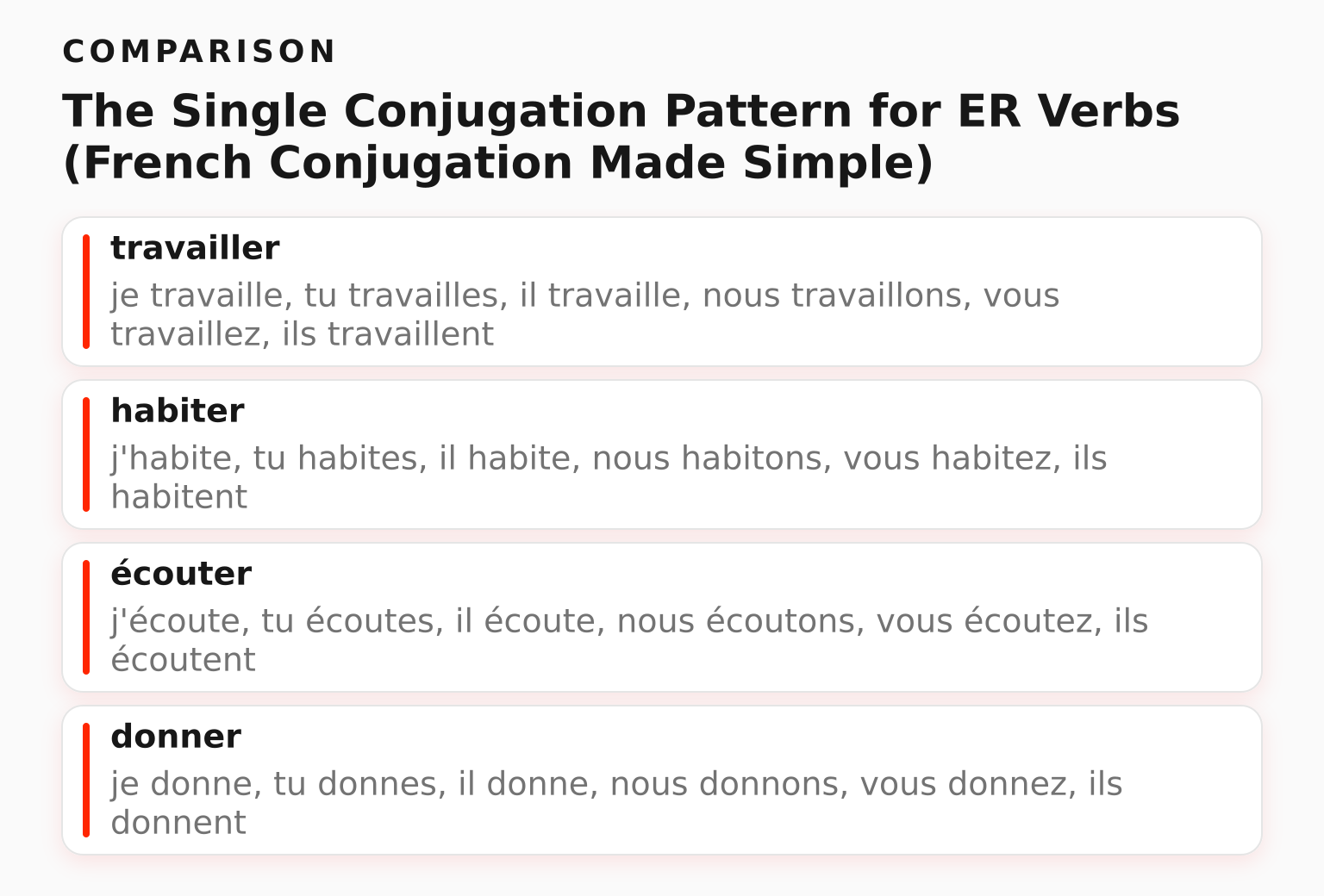
- travailler: je travaille, tu travailles, il travaille, nous travaillons, vous travaillez, ils travaillent
- habiter: j'habite, tu habites, il habite, nous habitons, vous habitez, ils habitent
- écouter: j'écoute, tu écoutes, il écoute, nous écoutons, vous écoutez, ils écoutent
- donner: je donne, tu donnes, il donne, nous donnons, vous donnez, ils donnent
Notice what did not change: the stem. Parler stays parl-, travailler stays travaill-, from je all the way to ils. Only the ending moves. That is why this group is called regular.
The Pronunciation Trap: Why Singular Forms All Sound the Same
In spoken French, the endings -e, -es, and -ent are silent. So je parle, tu parles, il parle, and ils parlent are all pronounced the same way: "parl."
You only hear a difference with nous (-ons) and vous (-ez).
This matters for two exam skills:
- Listening: when you hear "il travail... vous travaillez," the difference between a singular and plural subject often comes from the subject word itself, not the verb ending. Train your ear to catch the subject, not just the verb sound.
- Writing: because the endings are silent, candidates frequently leave them off or mix them up in writing. In the exam, that ending is visible on the page, and a missing -s or -ent is an accuracy error a grader can see instantly.
If your writing section is weak, silent endings are one of the cheapest points to recover. Slow down before you submit and check every verb ending against its subject.
Worked Examples: Four Verbs in the Present and One More Tense
The present tense covers a lot of exam writing, but TEF Canada tasks commonly ask you to connect past events to opinions, so you also need one past tense. The passé composé of -ER verbs is simple: use avoir + the past participle, which is the infinitive minus -er plus é.
Parler (to speak)
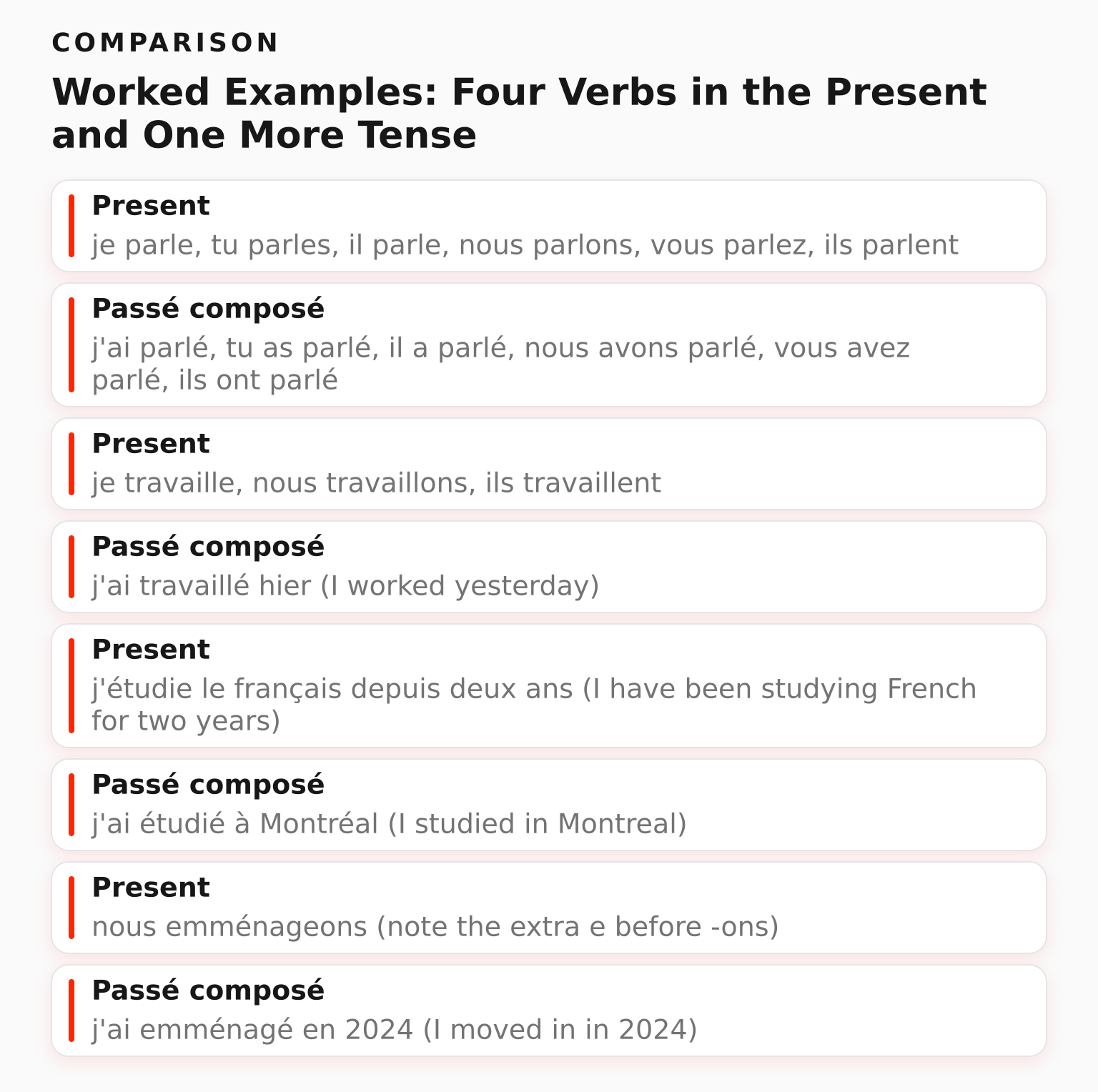
- Present: je parle, tu parles, il parle, nous parlons, vous parlez, ils parlent
- Passé composé: j'ai parlé, tu as parlé, il a parlé, nous avons parlé, vous avez parlé, ils ont parlé
Travailler (to work) - Present: je travaille, nous travaillons, ils travaillent - Passé composé: j'ai travaillé hier (I worked yesterday)
Étudier (to study) - Present: j'étudie le français depuis deux ans (I have been studying French for two years) - Passé composé: j'ai étudié à Montréal (I studied in Montreal)
Emménager (to move in, spelling-change verb) - Present: nous emménageons (note the extra e before -ons) - Passé composé: j'ai emménagé en 2024 (I moved in in 2024)
One useful bonus: with -ER verbs, the past participle (parlé, travaillé, étudié) sounds identical to the je form of the present. French itself takes advantage of this, which is why sentences like "j'ai travaillé et je travaille encore" are easy to build.
The Must-Know -ER Verb List, Grouped by What It Lets You Say
This list is not a claim about which verbs statistically appear in past exam papers. It is a functional list: verbs chosen because they let you describe work, routine, opinions, and arguments, which is what the TEF and TCF writing and speaking tasks ask you to do.
Verbs for Giving Opinions
These are your Section B workhorses. When the task asks what you think of a statement, these verbs build the response.
- aimer (to like), préférer (to prefer), détester (to hate), adorer (to love)
- penser (to think), croire (to believe), trouver (to find, as in "je trouve que...")
- approuver (to approve), appuyer (to support)
- partager (to share), accepter (to accept), refuser (to refuse)
- rester (to stay), demeurer (to remain), sembler (to seem)
Example sentences you can adapt: - Je pense que cette décision est une bonne chose. (I think this decision is a good thing.) - Je préfère travailler depuis chez moi. (I prefer working from home.) - Je trouve que les grandes villes offrent plus d'opportunités. (I find that big cities offer more opportunities.)
Verbs for Daily Life and Work
Section A asks you to continue a news article. These verbs let you describe people, routines, and events in a concrete way.
- travailler (to work), habiter (to live), déménager (to move house), emménager (to move in)
- étudier (to study), enseigner (to teach), réviser (to revise)
- manger (to eat), préparer (to prepare), acheter (to buy), dépenser (to spend)
- arriver (to arrive), quitter (to leave), fermer (to close), allumer (to switch on)
- travailler à temps partiel, louer (to rent), prêter (to lend)
- marcher (to walk), voyager (to travel), visiter (to visit), garder (to look after)
- casser (to break), tomber (to fall), montrer (to show), regarder (to watch)
- téléphoner (to phone), organiser (to organize), participer (to take part), aider (to help)
Example sentences: - La famille a déménagé dans un nouvel appartement le mois dernier. (The family moved into a new apartment last month.) - Ils travaillent dans le quartier depuis dix ans. (They have worked in the neighborhood for ten years.) - Les habitants du quartier ont organisé une réunion. (The neighborhood residents organized a meeting.)
Verbs for Building Arguments
Section B needs at least three arguments. These verbs introduce and develop them.
- expliquer (to explain), développer (to develop), démontrer (to demonstrate)
- améliorer (to improve), augmenter (to increase)
- encourager (to encourage), décourager (to discourage), influencer (to influence)
- empêcher (to prevent), changer (to change), échanger (to exchange)
- constater (to observe), remarquer (to notice), souligner (to stress), montrer (to show), prouver (to prove)
- progresser (to progress), économiser (to save money), profiter (to benefit)
A few argument verbs you will see in model answers are not -ER verbs, like permettre (to allow) and réduire (to reduce). They follow different patterns, so learn them separately. In the infinitive after de, though, they are safe to use as they are: "permet de réduire les coûts."
Example sentences: - Travailler à distance permet de réduire les coûts de transport. (Working remotely makes it possible to reduce transport costs.) - Cette mesure encouragerait les jeunes à étudier. (This measure would encourage young people to study.) - Des études montrent que la pollution a augmenté dans la région. (Studies show that pollution has increased in the region.)
Notice how often -ER verbs appear in the infinitive after pour, je vais, je veux, and il faut: "pour améliorer," "je veux déménager," "je vais expliquer." The infinitive form is a free point: no conjugation needed, and it is grammatically correct.
Spelling-Change -ER Verbs to Watch
Most -ER verbs are perfectly regular. A small, predictable set changes spelling in certain forms to keep the pronunciation consistent. These five patterns cover almost all of them:
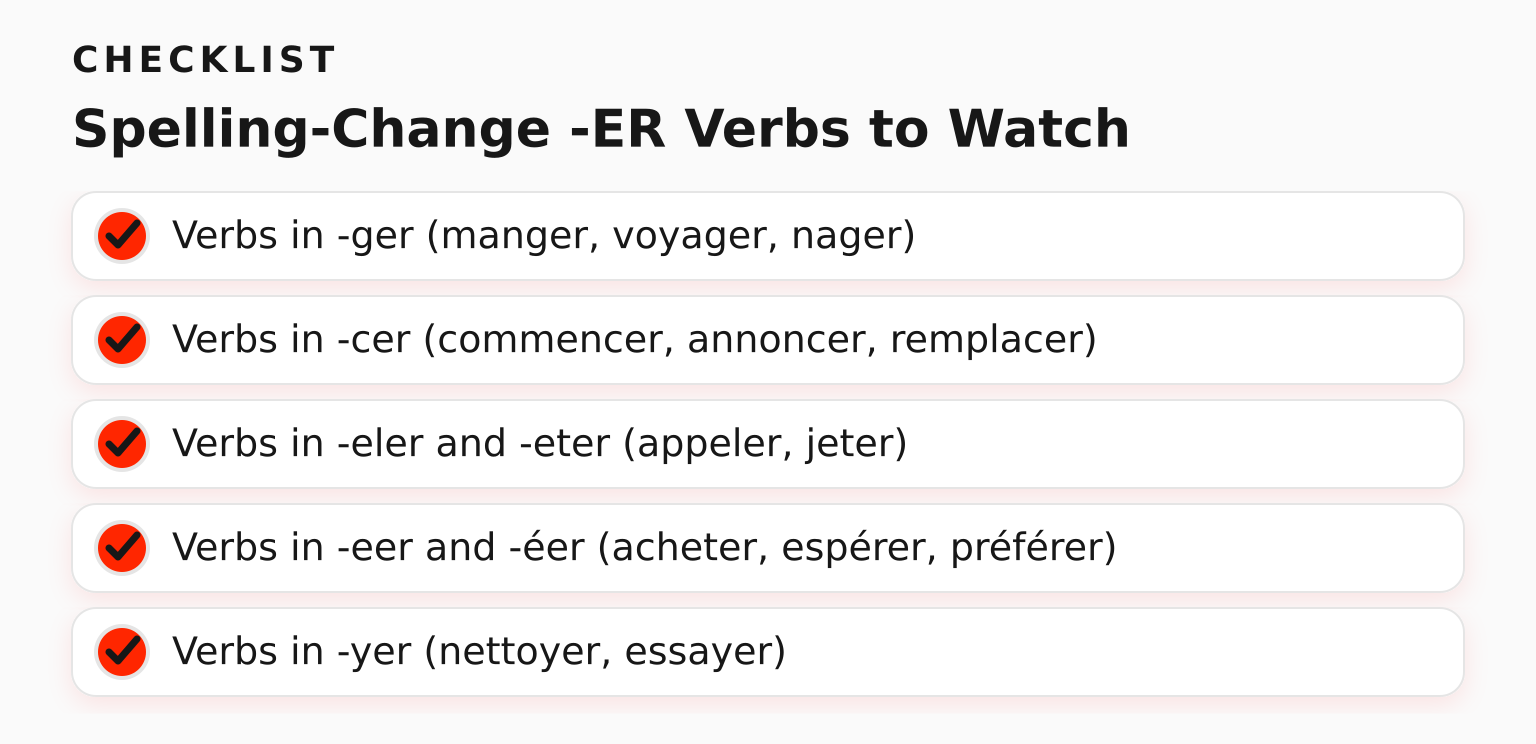
- Verbs in -ger (manger, voyager, nager): add an e before endings that start with a or o. Nous mangeons, nous voyageons. Without it, the g would sound hard, like "g" in "go."
- Verbs in -cer (commencer, annoncer, remplacer): add a cedilla (ç) before a or o. Nous commençons. Without it, the c would sound like "k."
- Verbs in -eler and -eter (appeler, jeter): double the consonant in je, tu, il/elle/on, and ils/elles forms. J'appelle, il jette, but nous appelons.
- Verbs in -e_er and -é_er (acheter, espérer, préférer): the e or é becomes è in the singular and third-person plural forms. J'achète, je préfère, il espère, but nous préférons.
- Verbs in -yer (nettoyer, essayer): the y becomes i in the singular forms. Je nettoie, il essaie, but nous nettoyons.
Here is why this matters for your score: an examiner reading your Section B letter sees "nous mangons" and instantly knows the difference between a learner who knows the pattern and one who applies it blindly. Learning these five groups takes maybe 20 minutes and prevents a recurring error type. For fuller exception lists, lovelearninglanguages.com and FluentU's -ER verb guide both cover the spelling-change families in detail.
How These Verbs Show Up in TEF Canada and TCF Canada Tasks
In the TEF Canada written expression, you complete two sections in 60 minutes. Section A gives you the start of a news article (about 40 words) and asks you to continue it with at least 80 more words. Section B gives you a statement from a newspaper and asks you to write a letter responding to it, at least 200 words, with at least three arguments. The official exam page from le français des affaires confirms this two-section, 60-minute structure.
The TCF Canada written expression follows a similar pattern: a descriptive or narrative task and an argumentative task, with the argumentative task weighted for B2-level candidates. For most immigration candidates, that B2-level writing is where the -ER verbs earn their keep.
Here is how the verb list above maps to the tasks:
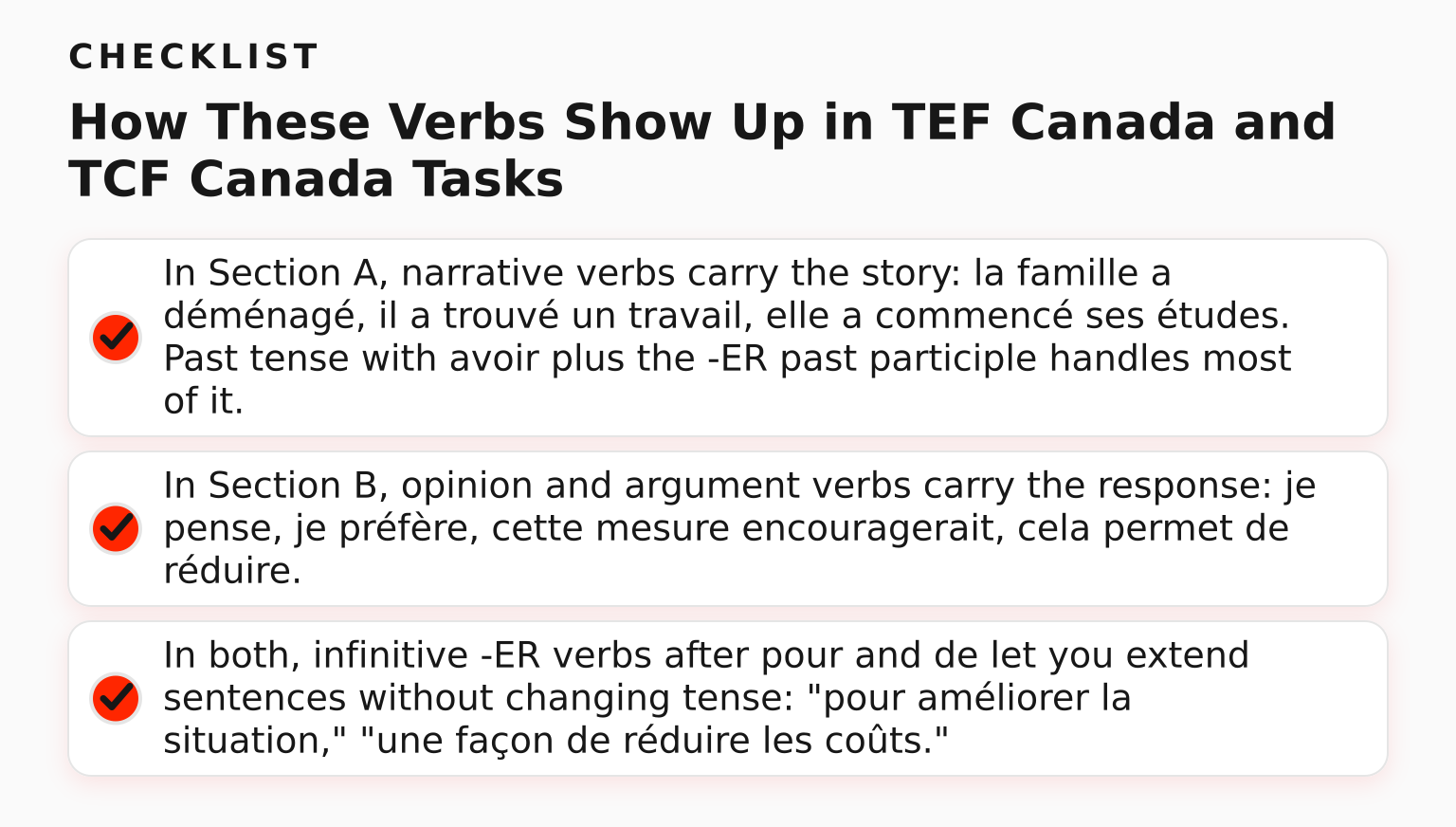
- In Section A, narrative verbs carry the story: la famille a déménagé, il a trouvé un travail, elle a commencé ses études. Past tense with avoir plus the -ER past participle handles most of it.
- In Section B, opinion and argument verbs carry the response: je pense, je préfère, cette mesure encouragerait, cela permet de réduire.
- In both, infinitive -ER verbs after pour and de let you extend sentences without changing tense: "pour améliorer la situation," "une façon de réduire les coûts."
Common Exam-Accuracy Pitfalls with -ER Verbs
- Silent endings left off in writing. Because je parle and ils parlent sound identical, candidates drop the -ent in writing. Always write the full ending; the grader sees the page, not your pronunciation.
- Accent changes forgotten. Acheter becomes j'achète, not j'achete. Espérer becomes j'espère, but nous espérons. The accent moves in exactly the forms where the ending is silent, which is why they pair up.
- A handful of -ER verbs use être in the passé composé. Almost all -ER verbs take avoir. But a small set of movement verbs, like monter (to go up), descendre (not -ER), rester, tomber, and retourner, take être when the meaning is movement: je suis resté à la maison, il est tombé. Treat rester, tomber, monter, retourner, and their close cousins as a separate memorization item rather than assuming avoir everywhere.
- The nous form of -ger and -cer verbs. Nous mangeons and nous commençons look odd precisely because they are correct. Do not "fix" them.
- Mixing tu and vous endings. Tu always gets -es, vous always gets -ez. In a formal letter to a newspaper, vous is the safe choice, and its -ez ending is one you will write many times.
Drill the Pattern Until It Is Automatic
The pattern is one page of notes. Making it automatic is a different job. Here is a simple weekly drill:
- Pick five verbs from the list above. Conjugate each fully in the present tense, out loud, in under a minute per verb.
- Write two sentences per verb: one in the present, one in the passé composé. Use subjects that vary (je, nous, ils) so the silent-ending problem gets practice too.
- Once a week, write a short Section A-style news continuation (80 words) and a Section B-style opinion paragraph (100 words) using only verbs from your list.
If you want a structured next step, the TEF Canada Writing Cheat Sheet (NCLC 7+) shows the frameworks these verbs plug into for Section A and B. The same list works in speaking, and the TEF Canada Speaking Template covers how to deploy verbs under time pressure. For the surrounding vocabulary, see TEF Canada Vocabulary by Theme, and for more grammar and strategy guides, browse the TEF and TCF Canada blog.
Once the pattern feels automatic, timed practice is what converts it into exam points. You can start free practice on CanadaFrenchPath with 1,000 credits, including writing tasks with AI grading and feedback across all four skills. If you are planning your timeline, the NCLC 7+ time estimator gives you a realistic picture of how long your current level needs.