
Summary of the Article
Only one TCF version works for a Canadian PR file: TCF Canada. Express Entry accepts exactly two French tests, TEF Canada and TCF Canada, and no others (canada.ca). TCF Tout Public (TCF TP) is the general-purpose exam for study, work, or personal goals in France. IRCC does not list it, its results do not convert to NCLC, so it earns you zero CRS points. TCF Québec is the modular version built for Québec (MIFI) permanent immigration files.
- TCF Canada: 4 compulsory skills, 2h47, scores convert to NCLC. The right booking for Express Entry and PR.
- TCF Tout Public (TP): 3 compulsory multiple-choice modules (about 1h25) plus optional writing and speaking. Legitimate for French universities and employers, but not for a federal immigration file.
- TCF Québec: modular format for MIFI permanent selection in Québec.
- Citizenship nuance: IRCC treats TCF results differently for citizenship than for Express Entry. Read the citizenship section before you rely on any TCF certificate for a citizenship application.
Quick Answer: Which TCF Variant Do You Need?
Match the test to the office processing your file:
| Your goal | Book this |
|---|---|
| Express Entry or PR outside Québec | TCF Canada only |
| Permanent immigration to Québec | TCF Québec, or TCF Canada (MIFI accepts both) |
| Study, work, or personal certification in France | TCF Tout Public |
| Canadian citizenship | TCF Canada is the safest TCF option; see the citizenship section below |
If you are still deciding between the two exam families rather than the TCF versions, our guide to TEF Canada vs TCF Canada covers that choice in depth. There is also a wider comparison of the two tests at standardizedtests.org if you want a second opinion.
The One Difference That Matters: IRCC Acceptance
IRCC publishes the list of language tests it accepts for Express Entry on canada.ca. The French column contains exactly two entries: TEF Canada and TCF Canada (canada.ca).
TCF Tout Public is not on that list. That means a TP certificate cannot generate CRS points, no matter how well you scored. This single fact settles the "tcf canada vs tcf tout public" question for almost every reader here: if your file goes to IRCC, you book TCF Canada.
The reason is structural, not political. Express Entry scores each of the four abilities separately and converts each to an NCLC level. A TCF TP sitting usually covers listening, grammar, and reading only, with writing and speaking optional. IRCC needs a complete, four-skill file, and only TCF Canada (or TEF Canada) guarantees that.
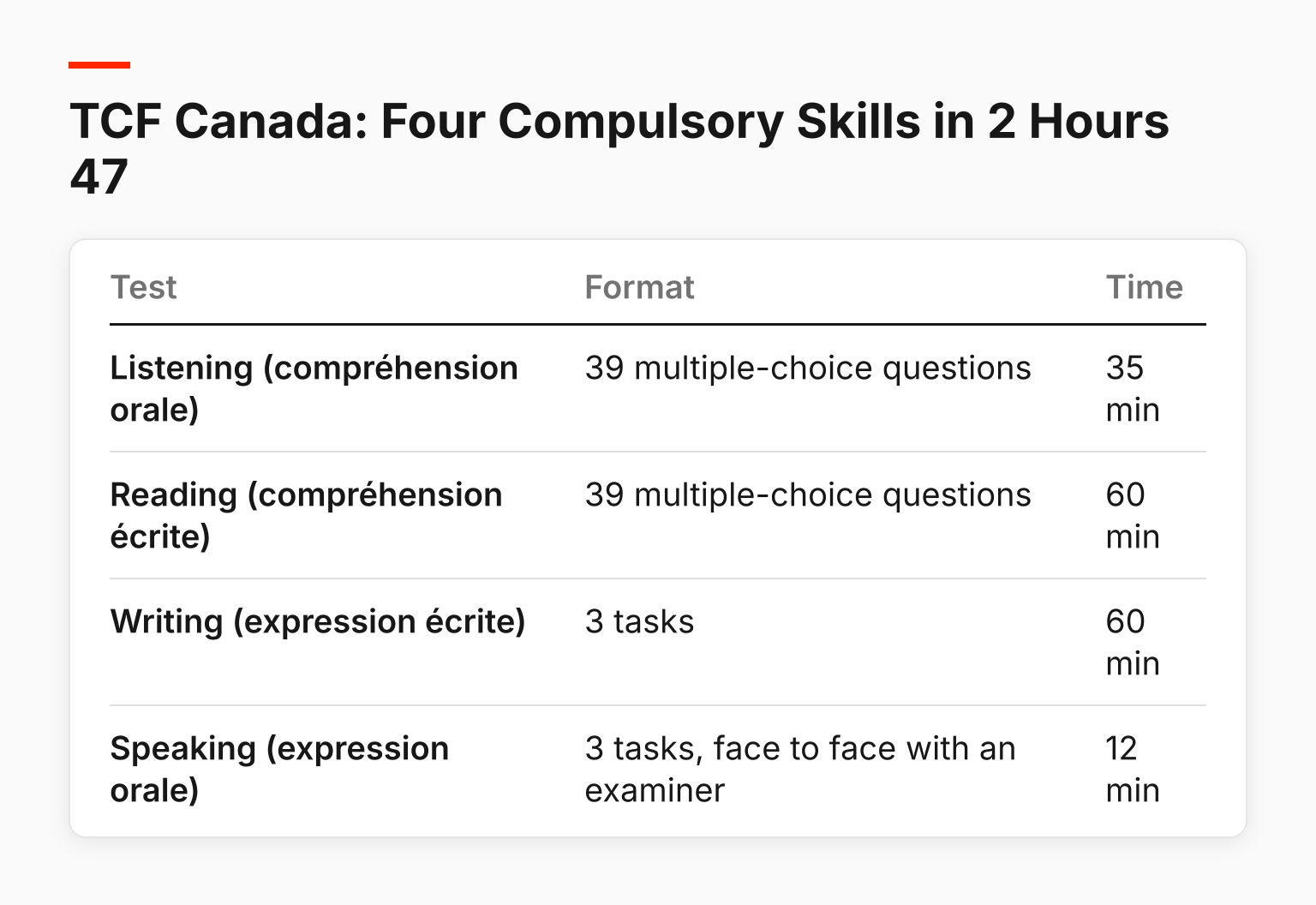
TCF Canada: Four Compulsory Skills in 2 Hours 47
TCF Canada was built for IRCC files, including economic immigration and Canadian citizenship applications. It has four compulsory tests and runs 2 hours 47 minutes in total (candidate manual):

| Test | Format | Time |
|---|---|---|
| Listening (compréhension orale) | 39 multiple-choice questions | 35 min |
| Reading (compréhension écrite) | 39 multiple-choice questions | 60 min |
| Writing (expression écrite) | 3 tasks | 60 min |
| Speaking (expression orale) | 3 tasks, face to face with an examiner | 12 min |
Your certificate gives a score out of 699 for listening and reading, a mark out of 20 for writing and speaking, and a CEFR level per skill. IRCC converts each score to an NCLC level. To hit NCLC 7, the level most Express Entry candidates target, you need roughly 458 in listening, 453 in reading, and 10 out of 20 in writing and speaking (canada.ca). Our NCLC conversion guide shows the full chart for every score band.
Because all four skills are compulsory, there is no partial version of TCF Canada. That is by design. For the complete picture on prep and scoring, see our TCF Canada guide.
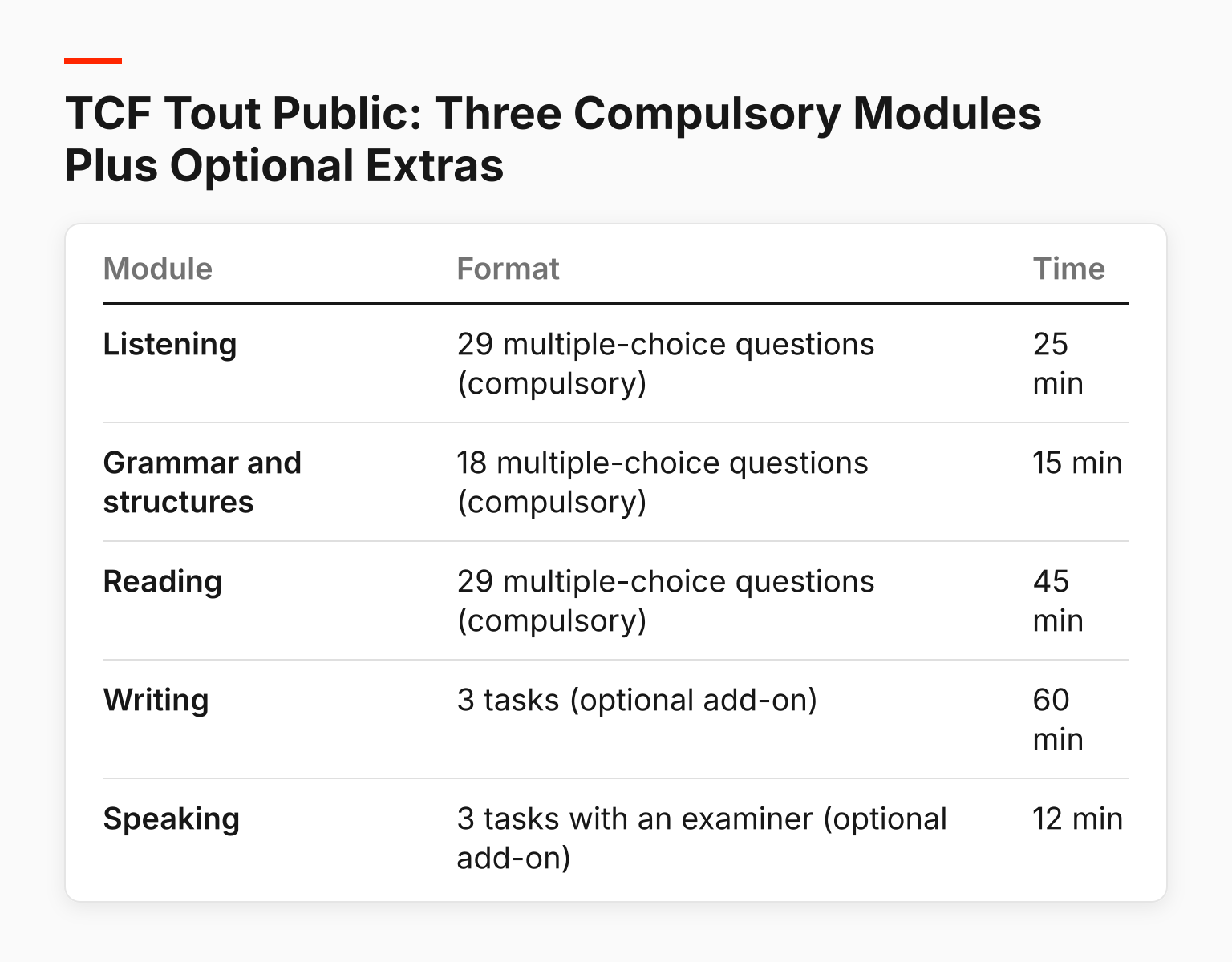
TCF Tout Public: Three Compulsory Modules Plus Optional Extras
TCF Tout Public is France Éducation international's general exam. It serves students applying to French universities, employees, and anyone who wants a certified level for personal reasons. Its structure is very different from TCF Canada (candidate manual):
| Module | Format | Time |
|---|---|---|
| Listening | 29 multiple-choice questions (compulsory) | 25 min |
| Grammar and structures | 18 multiple-choice questions (compulsory) | 15 min |
| Reading | 29 multiple-choice questions (compulsory) | 45 min |
| Writing | 3 tasks (optional add-on) | 60 min |
| Speaking | 3 tasks with an examiner (optional add-on) | 12 min |
So the compulsory core is 76 questions in 1h25, with no grammar module in TCF Canada and no compulsory writing or speaking in TCF TP. You only sit the written and spoken parts if you choose to.
Results come back as CEFR levels from A1 to C2 per skill. There is no NCLC conversion, because IRCC's grid was never designed for this exam. A TP certificate is a legitimate, useful document. It just answers a different question: "what is my French level?" rather than "can this person meet Canada's immigration language bar?"
TCF Québec: Built for MIFI Files
TCF Québec (TCFQ) targets one office: the Québec immigration ministry (MIFI), for permanent selection files. It covers the same four skills as TCF Canada, but the format is modular: you pick 1, 2, 3, or 4 of the tests depending on what your Québec program requires (UQAM test centre). MIFI then converts your results to its own French scale, with speaking and listening worth the most points.
One caution. MIFI's list of accepted tests actually includes TCF-Québec, TCF-Canada, and the plain TCF (quebec.ca). "Québec accepts it" is therefore not the same as "one test fits everything." The modules your program requires and the scoring differ from one test to another, so check the exact requirements of your Québec stream before paying for any session.
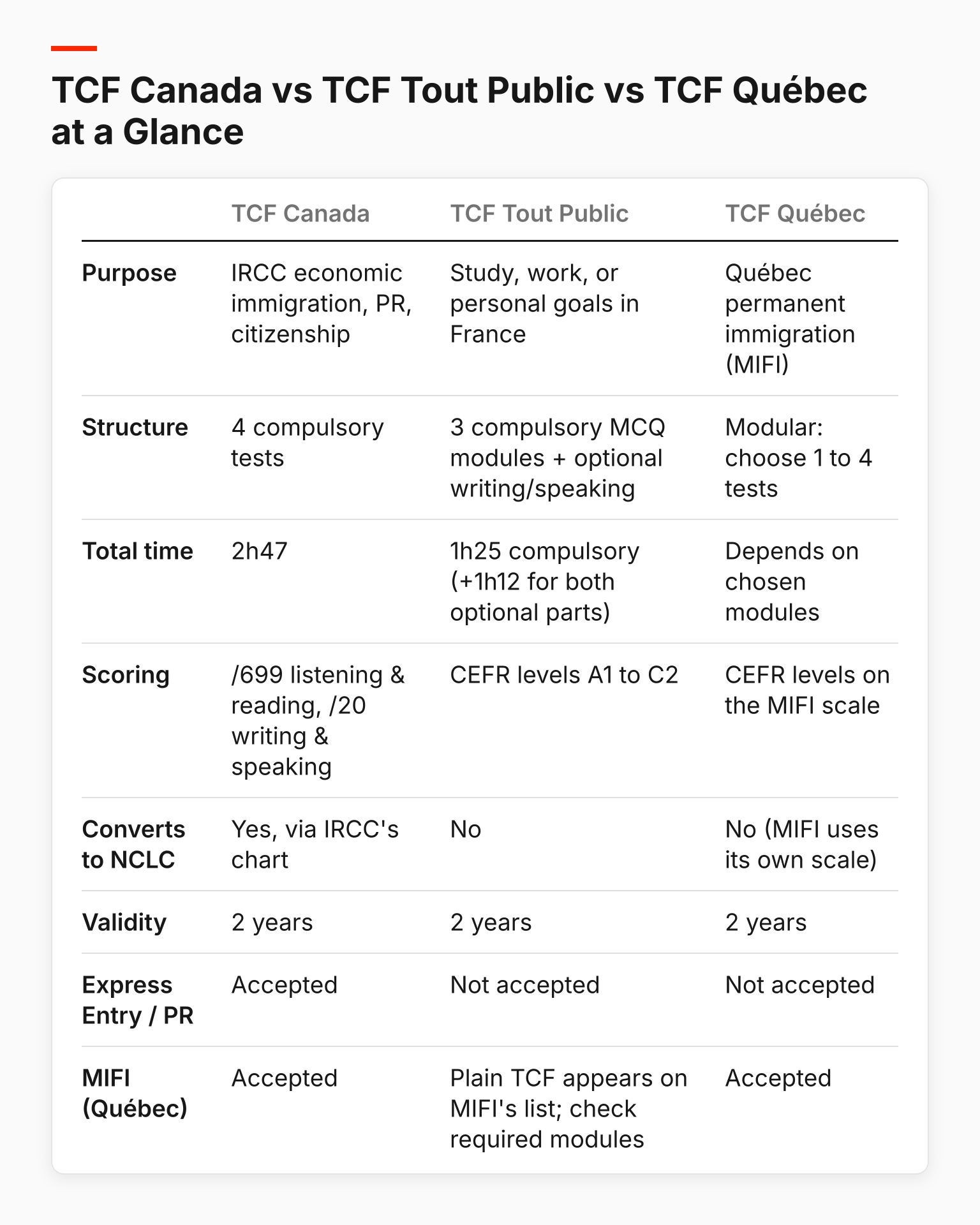
TCF Canada vs TCF Tout Public vs TCF Québec at a Glance
| TCF Canada | TCF Tout Public | TCF Québec | |
|---|---|---|---|
| Purpose | IRCC economic immigration, PR, citizenship | Study, work, or personal goals in France | Québec permanent immigration (MIFI) |
| Structure | 4 compulsory tests | 3 compulsory MCQ modules + optional writing/speaking | Modular: choose 1 to 4 tests |
| Total time | 2h47 | 1h25 compulsory (+1h12 for both optional parts) | Depends on chosen modules |
| Scoring | /699 listening & reading, /20 writing & speaking | CEFR levels A1 to C2 | CEFR levels on the MIFI scale |
| Converts to NCLC | Yes, via IRCC's chart | No | No (MIFI uses its own scale) |
| Validity | 2 years | 2 years | 2 years |
| Express Entry / PR | Accepted | Not accepted | Not accepted |
| MIFI (Québec) | Accepted | Plain TCF appears on MIFI's list; check required modules | Accepted |
All three exams come from the same organisation, France Éducation international, and all three certificates expire two years after results are issued (tcf-tef.ca). The two-year clock matters twice in Express Entry: your results must be valid when you enter the pool and still valid when you submit your PR application (canada.ca).
The Citizenship Nuance: Read IRCC's List Carefully
Citizenship rules are not the same as Express Entry rules, and this is where most prep-site summaries get sloppy.
For citizenship, applicants aged 18 to 54 must show they speak and listen at CLB/NCLC 4 or higher. Two IRCC pages list the accepted tests, and they word the TCF entries differently:
- The IRCC help centre lists "Test de connaissance du français (TCF)" and "TCFQ" among accepted third-party tests (IRCC Q572).
- The citizenship language-proof page names TCF Canada and TCFQ specifically, requiring B1 or higher in listening and speaking (canada.ca).
IRCC does not spell out on those pages whether a TCF Tout Public certificate with the optional listening and speaking modules satisfies the requirement. The clearly listed TCF options for citizenship are TCF Canada and TCFQ. If you hold only a TP certificate and want to use it for citizenship, confirm with IRCC before you count on it. If you are booking a test now and citizenship is on your horizon, TCF Canada covers both goals, since it serves PR files today and the listening and speaking scores can support a citizenship file later.
Already Took TCF TP by Mistake?
You cannot convert, upgrade, or transfer a TP certificate into a TCF Canada result. TCF Canada is a separate exam with its own registration, its own four tests, and its own certificate. If your immigration file needs IRCC-accepted proof, plan a full TCF Canada sitting.
Two practical points. First, check your timeline: your new results must still be valid when you submit your profile and, later, your PR application, so a near-expiry window can force awkward choices. Second, check whether your TP results included writing and speaking at all. Even if they did, the certificate itself is not the one IRCC lists, so the scores still do not help your Express Entry profile.
How to Avoid Booking the Wrong Exam
Test centres mix up these names too, and most do not refund fees once you register. Before you pay:
- Copy the exact test name from the official list: TCF Canada, TCF Québec, or TCF tout public. "TCF" alone is not specific enough.
- Ask the centre to confirm in writing which TCF variant your session delivers.
- Check which modules are compulsory for your specific program before choosing optional parts.
- Confirm your results will still be valid at the date you expect to apply.
One forum note worth mentioning: candidates on Reddit often ask whether the TCF versions use different audio, such as more Québécois speakers in the Canada or Québec sessions. Those claims are anecdotes, not official information. The exam designs above, not the accents you expect to hear, should drive your booking.
Next Step: Prepare for the Right Test
If your file goes through IRCC, the decision is made: TCF Canada, all four skills, no shortcuts. Everything else on this page is context for why that is the answer.
The fastest way to start is practice that matches the real exam. CanadaFrenchPath prepares you for TEF Canada and TCF Canada across listening, reading, writing, and speaking, with mock exams, personalized study plans, and NCLC tracking. Start free practice with 1,000 credits and work from a full mock test with our free TCF Canada practice plan.