
Summary of the Article
A good TCF Canada practice test does two jobs: it copies the real exam's format, and its results tell you which of your four skills is holding back your immigration file. Start with France Éducation International's official specimen questions to calibrate, take one full diagnostic under real timing, then turn your weakest section into a weekly routine that ends with full timed mocks.
- Official FEI specimens: real sample questions from the test maker; calibration material, not an unlimited mock bank.
- TV5Monde: free TCF simulator built with FEI; covers the three comprehension-style sections, and the level estimate is only indicative.
- Third-party mock exams: can cover all four skills; check that the format matches before you trust any score.
- CanadaFrenchPath: four-skill practice, mock exams with AI grading and NCLC tracking; you can start free with 1,000 credits.
You cannot book a seat at a real TCF Canada session and hope your first attempt is your best one. Retakes cost money and take weeks to schedule. A practice test is the cheapest way to find out where you stand today, and this guide walks you through the whole cycle: get realistic material, take an honest diagnostic, read the results correctly, and build a routine that actually moves your NCLC levels.
If you want the background first, our TCF Canada Guide (2026): Format, Scores & Immigration covers the exam structure, scoring and immigration rules in depth. This article focuses on the practice-test workflow itself.
What Makes a TCF Canada Practice Test Realistic
Not every practice test deserves your time. A realistic one matches the official exam section for section, because your diagnostic is only as honest as the format it uses.
The official TCF Canada has four mandatory sections, totalling 2 hours and 47 minutes:
| Section | Format | Duration | Scoring |
|---|---|---|---|
| Listening (compréhension orale) | 39 multiple-choice questions | 35 minutes | Points scale (0 to 699) |
| Reading (compréhension écrite) | 39 multiple-choice questions | 60 minutes | Points scale (0 to 699) |
| Writing (expression écrite) | 3 tasks | 60 minutes | Marked out of 20 |
| Speaking (expression orale) | 3 tasks with an examiner | 12 minutes | Marked out of 20 |
These figures come from France Éducation international's candidate manual, and one detail matters more than people expect: each listening recording plays only once. If your practice test lets you replay the audio, it is training a habit you cannot use on exam day.
Two more checks separate a realistic practice test from a lookalike:
- Task fidelity. The writing section has three specific tasks with word limits (roughly 60 to 120, 120 to 150, and 120 to 180 words). The speaking section has three timed tasks: a guided interview, an interactive exercise, and expressing a point of view. A mock that gives you one generic essay or one conversation topic is not a TCF Canada mock.
- Right version. FEI publishes several TCF versions, including TCF Canada, TCF Québec and TCF IRN. They differ in speaking task lengths and scoring use. Calibrate against TCF Canada material specifically.
Where to Find Legitimate Free Practice Material
Here is the trust signal you should know before downloading anything: FEI, the organisation that makes the TCF, publishes specimen examples, not unlimited "official full mocks." Any site advertising "official full TCF Canada practice tests" is misrepresenting what exists.
The material worth your time, in order of trust:
- FEI's own specimen questions. France Éducation international publishes example papers for the TCF on its website. This is the closest thing to official calibration material. Use it to learn the question style, the difficulty progression and the pacing of the real comprehension sections.
- TV5Monde's TCF training. TV5Monde runs a free TCF preparation platform built in partnership with FEI's TCF team, with more than 600 questions and a simulator that gives you 80 questions in 90 minutes with no pauses. Its limits are honest and stated on the site: it covers listening, reading and grammar but not writing or speaking, and the level estimate is indicative only. That makes it a good drill source, not a full diagnostic.
- Third-party mock exams. Several providers sell or give away full four-skill TCF Canada mocks. Quality varies. Before you rely on one, confirm it follows the format table above and that the provider is traceable, and read our guide to finding the best TEF Canada practice exams, free and paid for a screening process that also applies to TCF material.
Forum PDFs and "leaked official questions" deserve a hard pass. Their origin is unverifiable, their format is often years out of date, and trading in real exam content raises exam-security problems that can follow a candidate. The stakes are your immigration file; it is not worth building your prep on material nobody can vouch for.
For the listening stamina part of your routine, RFI's Le français facile offers free news audio with transcripts at learner speed, which pairs well with timed comprehension drills.
Step 1: Take Your Diagnostic Under Exam Conditions
Your first practice test is a measurement, not a study session. The value comes from conditions, not just completion.
Set up like this:
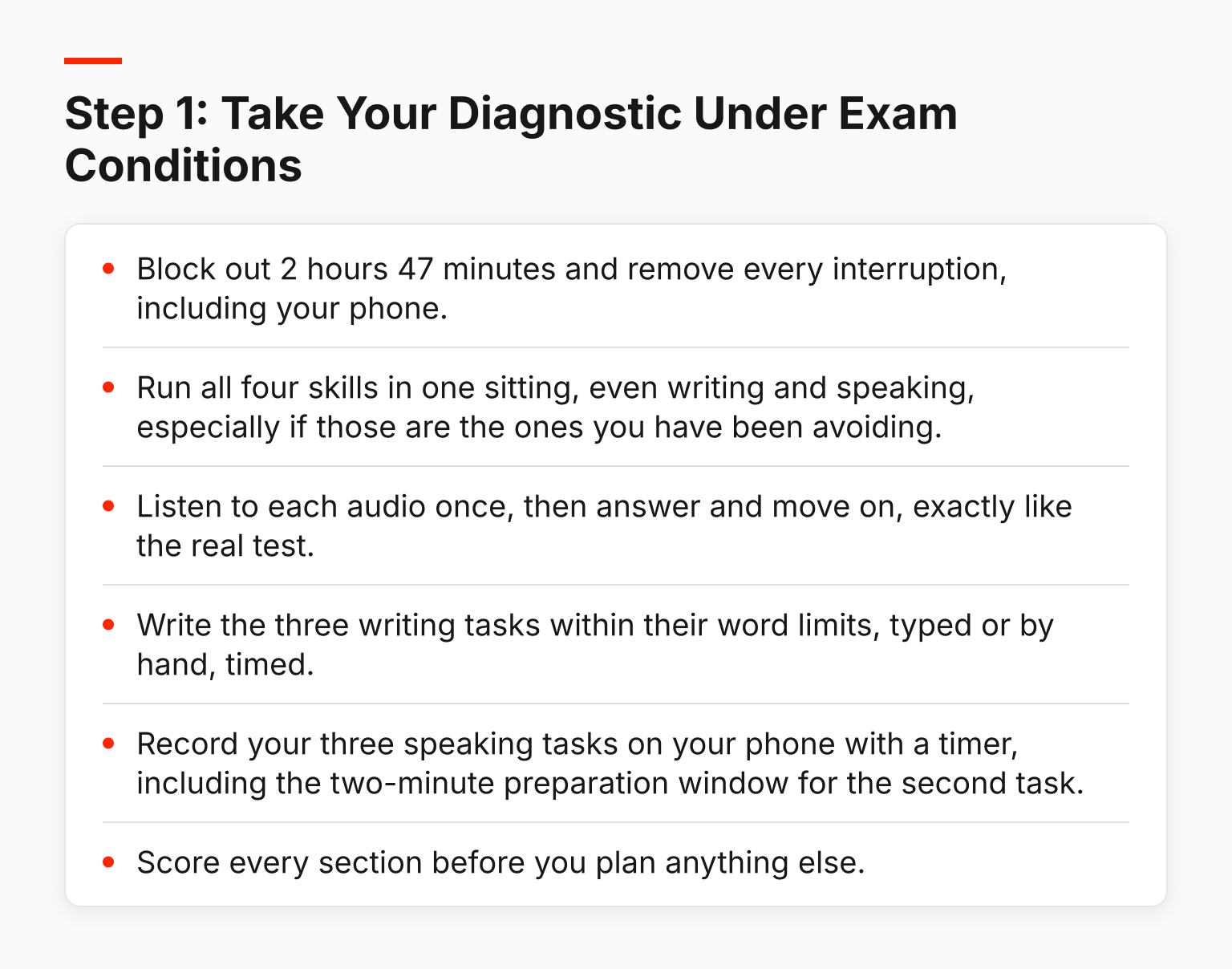
- Block out 2 hours 47 minutes and remove every interruption, including your phone.
- Run all four skills in one sitting, even writing and speaking, especially if those are the ones you have been avoiding.
- Listen to each audio once, then answer and move on, exactly like the real test.
- Write the three writing tasks within their word limits, typed or by hand, timed.
- Record your three speaking tasks on your phone with a timer, including the two-minute preparation window for the second task.
- Score every section before you plan anything else.
Yes, this feels uncomfortable. That discomfort is data. Many candidates discover their listening collapses after 20 minutes, or that they cannot fill 60 words coherently in writing. You want those discoveries now, not at a paid exam session.
Step 2: Read Your Results on the Right Scale
A common mistake is treating a TCF Canada result like a school grade. There is no overall score. Each of the four sections is scored separately, and they use two different scales:
- Listening and reading are scored on a points scale from 0 to 699.
- Writing and speaking are marked out of 20.
IRCC's official equivalency chart converts each section into an NCLC level. Here are the key bands for the TCF Canada:
| NCLC level | Listening | Reading | Writing | Speaking |
|---|---|---|---|---|
| 10 and above | 549 to 699 | 549 to 699 | 16 to 20 | 16 to 20 |
| 9 | 523 to 548 | 524 to 548 | 14 to 15 | 14 to 15 |
| 8 | 503 to 522 | 499 to 523 | 12 to 13 | 12 to 13 |
| 7 | 458 to 502 | 453 to 498 | 10 to 11 | 10 to 11 |
| 6 | 398 to 457 | 406 to 452 | 7 to 9 | 7 to 9 |
| 5 | 369 to 397 | 375 to 405 | 6 | 6 |
FEI and IRCC can revise scores and formats, so treat the chart on the IRCC site as the governing version.
Here is why the two scales matter for your mock: IRCC reads your four sections independently. If you are aiming for NCLC 7 across the file, a 520 in reading does not compensate for a 9 out of 20 in speaking. Your weakest section is the one that sets your ceiling, so your weakest section is where your study time goes.
One caveat: mock scores predict, they do not guarantee. Exam-day nerves, an unfamiliar room and a live examiner all pull results around. Treat a mock band as an estimate with a margin.
Step 3: Turn the Diagnosis into a 4-Skill Weekly Routine
A diagnostic without a routine is just an expensive bad mood. Build the week around the section that is furthest from NCLC 7:
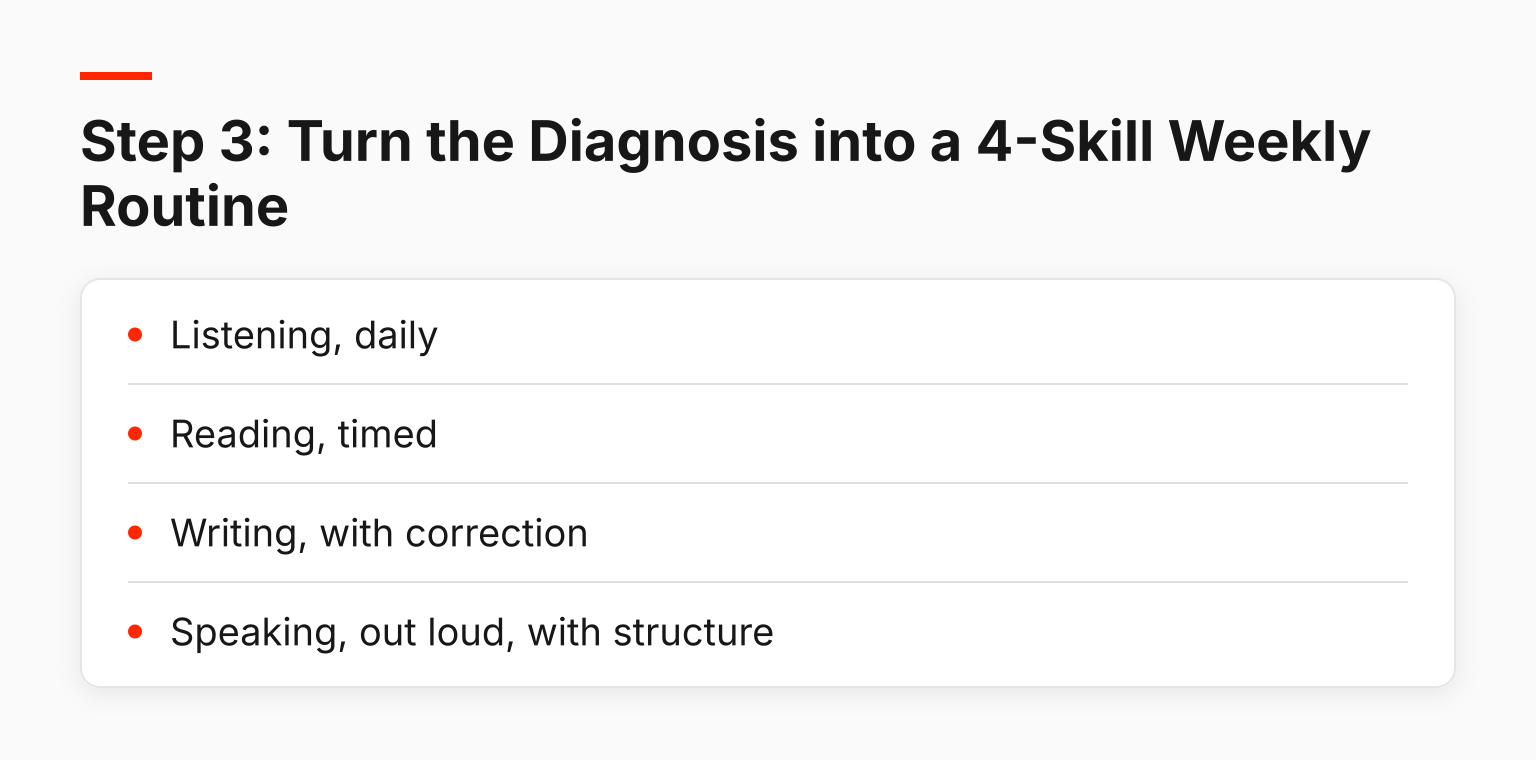
- Listening, daily. Even 15 minutes a day of exam-style audio beats one long weekend session. RFI's easy French news works well between timed drills.
- Reading, timed. You get 60 minutes for 39 questions, so practise finishing, not just understanding. Keep a list of every question you miss and why.
- Writing, with correction. Write one task per session against the real prompts and word limits, then get it corrected. Uncorrected writing practice cements your errors.
- Speaking, out loud, with structure. Record yourself on each of the three task types weekly. Listen back. Note where you freeze, repeat fillers or run out of things to say, and build reusable frames for each task.
Then weight the week toward your weakest skill: roughly half your sessions there, the rest spread across the other three. Every second week, re-drill the sections with fresh material so you are measuring progress, not memory.
Step 4: Move from Drills to Full Timed Mocks
Section drills build skill; full mocks build performance. In roughly the last four weeks before your exam, switch the emphasis: one full timed mock per week under strict exam conditions, then several days of review and targeted drills on what the mock exposed.
That review is where the improvement lives. After each mock:
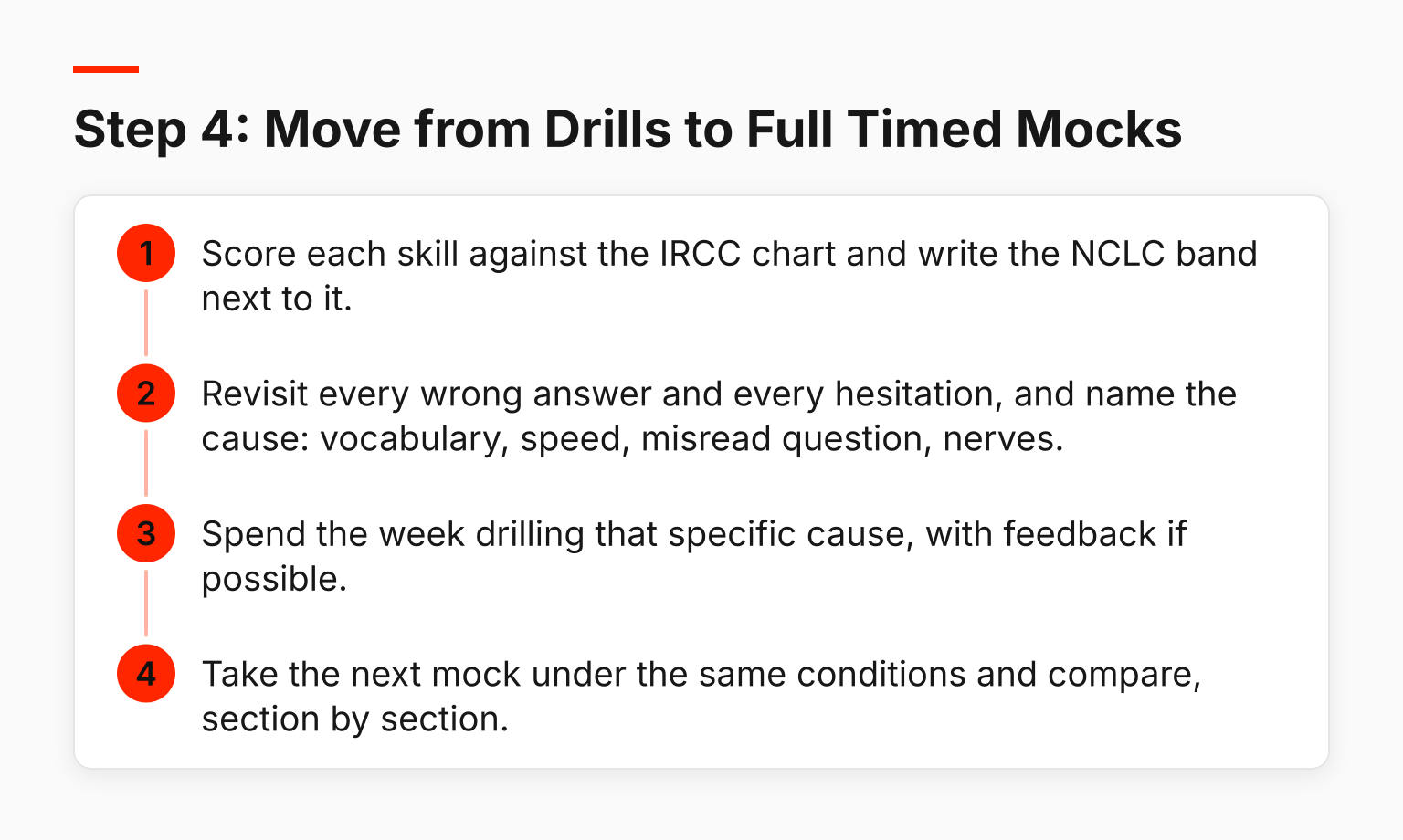
- Score each skill against the IRCC chart and write the NCLC band next to it.
- Revisit every wrong answer and every hesitation, and name the cause: vocabulary, speed, misread question, nerves.
- Spend the week drilling that specific cause, with feedback if possible.
- Take the next mock under the same conditions and compare, section by section.
When your last two mocks put all four sections at or above NCLC 7 with a small buffer, you are ready to book. If you want a structured place to run this cycle, CanadaFrenchPath's exam practice offers four-skill practice, mock exams with AI grading, live tutor support and NCLC tracking, alongside a personalised study plan built around your diagnostic result.
Five Failure Modes That Waste a Practice Test
- Practising grammar only. TCF Canada is a performance test. Grammar study helps, but only timed production in all four skills moves the score that counts.
- Calibrating with the wrong TCF version. TCF Québec and TCF IRN specimens differ from TCF Canada in task timing and use. Match the version to your goal.
- Ignoring speaking until the end. Speaking is marked out of 20, it is the section most candidates postpone, and it is the one where late cramming works least.
- Taking mocks without reviewing them. A mock you do not dissect is a mock you will repeat. The review is the training.
- Trusting a pretty score report. If a provider's result cannot be mapped to the IRCC chart, it is entertainment, not a diagnostic.
Track Your Progress and Know When to Book
Keep a simple log after every mock: date, four scores, NCLC bands, and your focus skill for the next week. When the bands stabilise at NCLC 7 or above across two mocks, you have your answer. If you are unsure how long the gap will take to close, the free NCLC 7+ time estimator turns your current level and weekly study hours into a realistic timeline.
Quick Questions
Is there an official free TCF Canada practice test? There are official specimen examples published by FEI, which is not the same as a complete official mock. Anyone claiming to offer unlimited "official full TCF Canada practice tests" is overselling.
What score is NCLC 7 on the TCF Canada? Per IRCC's chart: 458 to 502 in listening, 453 to 498 in reading, and 10 to 11 out of 20 in both writing and speaking.
How many practice tests should I take? One diagnostic at the start, then weekly full timed mocks in the final four weeks, with drills and review in between.
Run Your First Diagnostic This Week
The method above works with free material and a notebook. If you would rather have the mock exams, AI grading, tutor feedback and NCLC tracking in one place, you can sign up at CanadaFrenchPath and start free practice with 1,000 credits, take your first diagnostic, and see exactly which skill to attack next.