
TL;DR
The vocabulary that decides your TEF Canada or TCF Canada score clusters into a small set of recurring themes: daily life and routines, family, food and drinks, work, housing, health, transport, and services and administration. Each theme appears in specific exam sections, so you can prioritize instead of memorizing a dictionary.
- Daily life, food, family, and housing: they dominate everyday documents, listening scenarios, and speaking Section A, so they pay off fastest.
- Work and administration: they carry the hardest reading questions and speaking Section B arguments, so they need deeper study.
- Learn every noun with its article and inside a phrase, not as an isolated word. That method is explained in detail in How I Improved My French Vocabulary Faster by Stopping Word Lists.
- The lists below are curated starters, not exhaustive or official lists. They model how to build your own theme banks.
Why themes beat alphabetical word lists for TEF Canada
TEF Canada does not test vocabulary in the abstract. It tests whether you can handle realistic situations: phoning about an ad, reading a rental listing, arguing a point of view in a letter. The exam's owner, the Chambre de Commerce et d'Industrie de Paris Île-de-France, publishes the official TEF Canada format, and the structure explains which themes matter.
Two facts drive everything below:
- Reading comprehension is 40 questions in 60 minutes, built from documents of daily life, gapped sentences, fast reading, administrative and professional documents, and press articles.
- Oral and written expression are two sections each. Speaking Section A is a role play where you ask for information about a document such as an ad or announcement. Section B is a 10-minute exchange where you present and convince. Writing Section A continues a news article; Section B argues a point of view in a letter of about 200 words.
A theme like "food" is not just a nice category. Food and drinks vocabulary shows up in menus, party announcements, health tips, and reading documents, and it gives you concrete nouns you can reuse when you ask questions or build arguments.
Which themes appear in which section
Use this map to prioritize. A theme that touches three sections earns your study time before one that touches one.
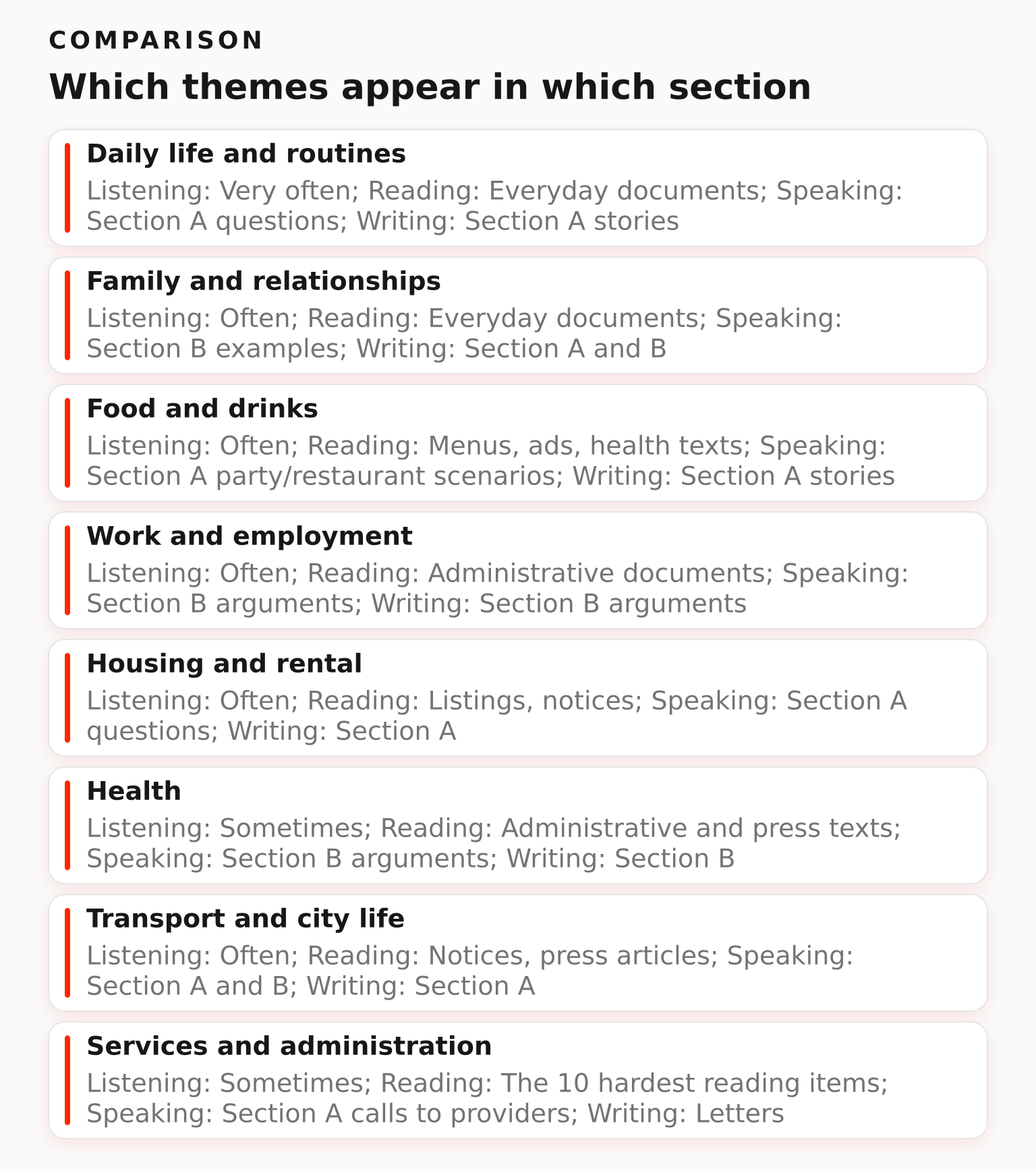
| Theme | Listening | Reading | Speaking | Writing |
|---|---|---|---|---|
| Daily life and routines | Very often | Everyday documents | Section A questions | Section A stories |
| Family and relationships | Often | Everyday documents | Section B examples | Section A and B |
| Food and drinks | Often | Menus, ads, health texts | Section A party/restaurant scenarios | Section A stories |
| Work and employment | Often | Administrative documents | Section B arguments | Section B arguments |
| Housing and rental | Often | Listings, notices | Section A questions | Section A |
| Health | Sometimes | Administrative and press texts | Section B arguments | Section B |
| Transport and city life | Often | Notices, press articles | Section A and B | Section A |
| Services and administration | Sometimes | The 10 hardest reading items | Section A calls to providers | Letters |
The official sample reading test confirms the split: questions 1 to 7 cover everyday documents, questions 23 to 32 cover administrative and professional documents, and questions 33 to 40 cover press articles. Preparation guides such as OpenExamPrep's reading breakdown recommend roughly 8 minutes for the 7 everyday items and about 16 for the 10 administrative ones, because administrative language is denser. Verify timing against official material, but the takeaway holds: everyday-document vocabulary pays off fast, and administrative vocabulary needs more work per point.
Theme 1: Daily life and routines
This is the backbone theme. Listening scenarios are everyday conversations, and speaking Section A asks you to interact about an announcement.
Starter nouns (always with the article): le rendez-vous (appointment), la journée (day), le matin / l'après-midi / le soir (morning / afternoon / evening), le billet (ticket), la perte (loss), l'horaire (m., schedule), la semaine (week), le week-end (weekend).
Core verbs: commencer (to start), finir (to finish), s'inscrire (to register), réserver (to book), annuler (to cancel), se renseigner (to find out).
Reusable collocations:
- prendre un rendez-vous (to make an appointment)
- s'inscrire à un cours (to sign up for a course)
- C'est ouvert tous les jours sauf le lundi. (It's open every day except Monday.)
Canadian French note: un cellulaire is a cell phone (not un portable), and un courriel is an email. You will meet both in Canadian documents.
Theme 2: Family and relationships
Family vocabulary is simple but high value, because it anchors listening conversations and gives you relatable examples in writing Section B.
Starter nouns: le/la parent (relative, careful: it means relative, not parent), les enfants (children), le couple (couple), le mariage (marriage), la vie de famille (family life), les petits-enfants (grandchildren), la belle-mère (mother-in-law or stepmother).
Core verbs: élever (to raise), se marier (to get married), habiter ensemble (to live together), s'entendre avec (to get along with).
Reusable collocations:
- passer du temps en famille (to spend time with family)
- avoir des enfants en bas âge (to have young children)
- s'entendre bien avec ses collègues (to get along well with colleagues)
Canadian French note: une garderie is daycare, a word that appears constantly in Canadian texts about family policy and services. Une école maternelle is the preschool option.
Theme 3: Food and drinks
If you searched for "food in french" or "drinks in french," here is the exam-framed version. Food shows up in menus, party announcements, health advice texts, and arguments about lifestyle.
Starter nouns: le repas (meal), le petit-déjeuner (breakfast), le déjeuner (lunch in France; breakfast in Canada!), le dîner (dinner in France; lunch in Canada), la nourriture (food), les boissons (f., drinks), l'eau (f., water), le plat (dish), les légumes (m., vegetables), les fruits (m., fruit).
Core verbs: manger (to eat), boire (to drink), cuisiner (to cook), commander (to order), goûter (to taste).
Reusable collocations:
- faire les courses (to do the grocery shopping)
- manger équilibré (to eat a balanced diet)
- réserver une table pour quatre personnes (to book a table for four)
Canadian trap: déjeuner and dîner mean breakfast and lunch in Canadian French but lunch and dinner in France. If a reading document is set in a Canadian context, read those words the Canadian way.
A note on "french animaux": animals appear far less often in TEF documents than food or work. Learn the common ones (un chien, un chat, un oiseau) for listening comprehension, but do not invest exam hours in an animals list.
Theme 4: Work and employment
This is where NCLC 7 (B2-level) reading gets hard. Administrative and professional documents lean heavily on employment vocabulary and standard abbreviations.
Starter nouns: le poste (position), l'emploi (m., job), le salaire (salary), l'entrevue (f., interview), le contrat (contract), l'expérience (f., experience), le diplôme (degree), l'employeur (m., employer), l'employé (m., employee), les heures de travail (f., working hours).
Core verbs: postuler (to apply), embaucher (to hire), travailler (to work), démissionner (to resign), gagner (to earn).
Abbreviations to recognize on sight: CDI (permanent contract), CDD (fixed-term contract), temps plein / temps partiel (full-time / part-time), CV, LM (lettre de motivation, cover letter), expérience exigée / souhaitée (experience required / preferred).
Reusable collocations:
- postuler à un poste (to apply for a position)
- être à la recherche d'un emploi (to be looking for a job)
- justifier son expérience (to back up one's experience)
Theme 5: Housing and rental
Rental listings are a classic everyday-document text, and housing is a favorite argument topic for writing Section B.
Starter nouns: le loyer (rent), l'appartement (m., apartment), le bail (lease), la caution (security deposit), les charges (f., utilities/building fees), le propriétaire (landlord), le locataire (tenant), le studio (studio), la pièce (room), l'annonce (f., listing/ad).
Core verbs: louer (to rent), déménager (to move), partager (to share), meubler (to furnish).
Reusable collocations:
- le loyer charges comprises (rent with utilities included)
- signer un bail d'un an (to sign a one-year lease)
- verser une caution (to pay a deposit)
Canadian French note: un stationnement is a parking lot or parking space; in France you will more often see un parking. Also watch the classic false friend: la location means rental, not location.
Theme 6: Services and administration
The 10 administrative reading questions live here. Bank letters, insurance notices, government forms, and university admission texts use formal register.
Starter nouns: la facture (bill), le dossier (file/case), la demande (request), le formulaire (form), le délai (deadline/delay), le service à la clientèle (customer service), le remboursement (refund), l'avis (m., notice), la preuve (proof), le justificatif (supporting document).
Core verbs: envoyer (to send), remplir (to fill in), fournir (to provide), payer (to pay), être remboursé (to be reimbursed).
Reusable collocations and formulas:
- sous réserve de validation (subject to approval)
- à compter du 1er mars (effective March 1st)
- joindre un justificatif (to attach a supporting document)
False friends to lock in now: un délai is a deadline or time period, not a delay (that's un retard). actuellement means currently, not actually (that's en fait). les chances are odds or chances, not luck (that's la chance in a positive sense; check context).
Theme 7: Health and transport (short takes)
Health. Nouns: la santé (health), le médecin (doctor), l'assurance (f., insurance), le médicament (medicine), la consultation (doctor's visit). Collocations: prendre rendez-vous chez le médecin (to book a doctor's appointment), être couvert par une assurance (to be covered by insurance). Health texts appear in both administrative and press reading items, so learn them in formal register.
Transport and city life. Nouns: le transport en commun (public transit), l'arrêt (m., stop), la station (station), le trajet (journey), le vélo (bike), la circulation (traffic). Collocations: prendre le bus tous les jours (to take the bus every day), être en retard à cause de la circulation (to be late because of traffic).
Canadian French note: in Canada you will mostly see l'autobus for bus (French texts more often use le bus), and a transit pass shows up on Canadian notices as un laissez-passer or un titre de transport. Reading those words the Canadian way keeps you oriented in local transit notices.
What matters most at NCLC 7, and what is noise
NCLC 7 corresponds to roughly B1-B2. Research on vocabulary size and CEFR levels suggests B2 learners typically recognize around 2,500 to 4,000 word families, with wide variation by language; see, for example, the Milton and Meara vocabulary-size work summarized in the CEFR vocabulary research literature. You do not need a giant list. You need the right slice.
Prioritize: daily life, work, housing, and administration. These four themes cover the largest share of reading documents, listening scenarios, and speaking prompts. Food, family, health, and transport are next.
Deprioritize for the exam: literature, slang, very regional idioms, and long animal or nature lists. They rarely appear in the documents or prompts, and C-level words do not move a B1-B2 score.
How to study each theme without rote lists
The site's core method is phrases over isolated words, and themed vocabulary is where you apply it. A short routine per theme:
- Collect nouns with articles. Never write "table," write "une table." The article is part of the word.
- Collect 3 to 5 collocations per theme, the ones above are starters. Say them aloud with the article and verb.
- Retrieval practice. Cover the list, write or say a 3-sentence mini-scenario using the theme. For example, in food: "Je réserve une table pour samedi. On prend un dessert? Oui, et le café est compris." Then check what you missed.
- Reuse across sections. Take five food collocations and build one speaking Section A question, one Section A story sentence, and one Section B argument with them.
Flashcards work if the card shows a phrase and forces production, not if it shows a translation pair you only recognize. For a fuller schedule and routine, see Self-Study for TEF Canada: Effective Tips & Strategies and the overall roadmap in How to Get NCLC 7 in TEF Canada (2026 Study Guide). And because listening costs you points on dates, prices, and phone numbers regardless of theme, pair this guide with French Numbers for TEF Canada Listening: Dates, Prices & Phone Numbers.
Common questions
How many words do you need for B1 or B2? There is no official number. Published research puts B1 receptive vocabulary around 2,000 word families and B2 roughly 2,600 to 4,000, and the estimates vary by study and language. The practical lesson is the same either way: depth on high-frequency themes beats breadth on rare words.
Flashcards or lists? Use themed lists to decide what to collect, then turn each item into a phrase-based card that forces you to produce the word with its article and a verb. Recognition-only cards build a passive vocabulary that stalls in speaking.
Does vocabulary differ between TEF Canada and TCF Canada? The themes are the same, because both tests target B1-B2 everyday and administrative language for Canadian immigration. The formats differ, so the task types you rehearse differ. If you are still choosing between the tests, start with TEF Canada vs TCF Canada: Which French Test Should You Take for Canadian Immigration?
Your next step
Pick two themes tonight, ideally daily life and work. Write five nouns with articles and three collocations each, then use them in a spoken mini-scenario. After that, test the same vocabulary under exam conditions: timed questions, a mock reading section, a speaking role play. That is where gaps show up. If you want that feedback loop built for you, sign up to start free practice with 1,000 credits on CanadaFrenchPath and use the mock exams, section drills, and NCLC tracking to turn these theme lists into points.