
Summary of the Article
NCLC 7 is a French language benchmark used by Immigration, Refugees and Citizenship Canada (IRCC). It means level 7 on the Niveaux de compétence linguistique canadien scale, and it applies to each of the four skills: listening, reading, writing, and speaking. On the TEF Canada, NCLC 7 means roughly 249–279 in listening, 207–232 in reading, and 310–348 in writing and speaking. On the TCF Canada, it means 458–502 in listening, 453–498 in reading, and 10–11 out of 20 in writing and speaking.
Key facts to take away:
- NCLC is the French scale; the English scale is CLB. NCLC 7 is roughly the French mirror of CLB 7.
- Federal Skilled Worker requires NCLC 7 in all four skills. Canadian Experience Class requires NCLC 7 for TEER 0 or 1 jobs, NCLC 5 for TEER 2 or 3.
- NCLC 7 in all four French skills earns a CRS bonus of 25 or 50 points, and qualifies you for French-language category draws.
- IRCC checks each skill separately. One skill below NCLC 7 fails an NCLC 7 requirement. No averaging.
What NCLC 7 actually means
NCLC stands for Niveaux de compétence linguistique canadien. It is Canada's official scale for describing French language ability, from low beginner to advanced. It runs from NCLC 1 to well past NCLC 10, and every level describes what you can actually do, not just how many test points you got.
The English-language version of the same system is called CLB, the Canadian Language Benchmarks. NCLC 7 is the French equivalent of CLB 7 in spirit: a strong intermediate level where you can handle everyday and work situations without much trouble.
In practical terms, a person at NCLC 7 can:
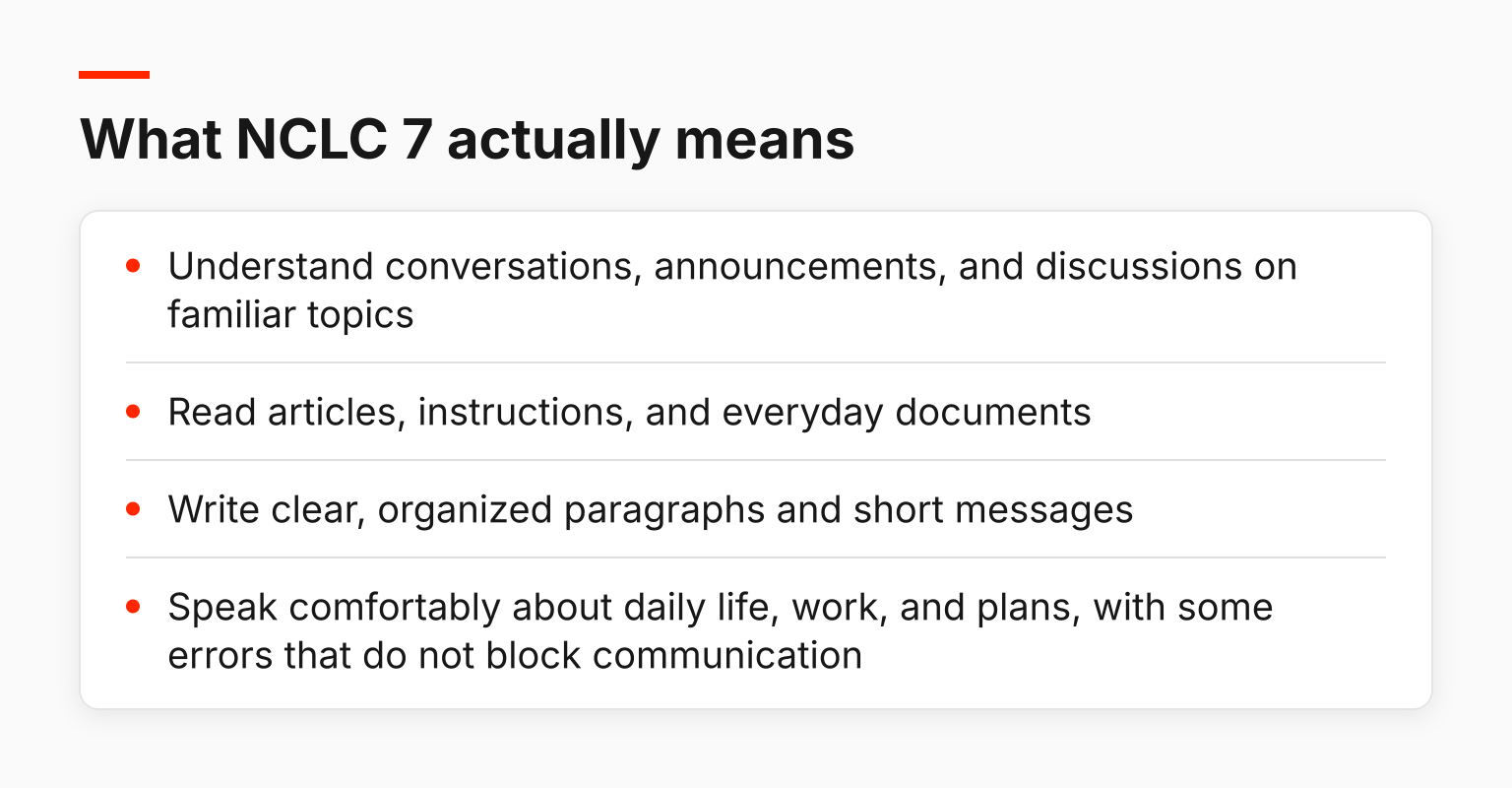
- Understand conversations, announcements, and discussions on familiar topics
- Read articles, instructions, and everyday documents
- Write clear, organized paragraphs and short messages
- Speak comfortably about daily life, work, and plans, with some errors that do not block communication
If you have heard CEFR levels like B2, that is the closest everyday comparison. NCLC 7 sits roughly at the B2 range, though the two scales are not officially identical.
NCLC 7 on TEF Canada: exact scores per skill
IRCC publishes the official conversion between test scores and NCLC levels. Here is what NCLC 7 requires on the TEF Canada, using the "Équivalence ancien score" scale:
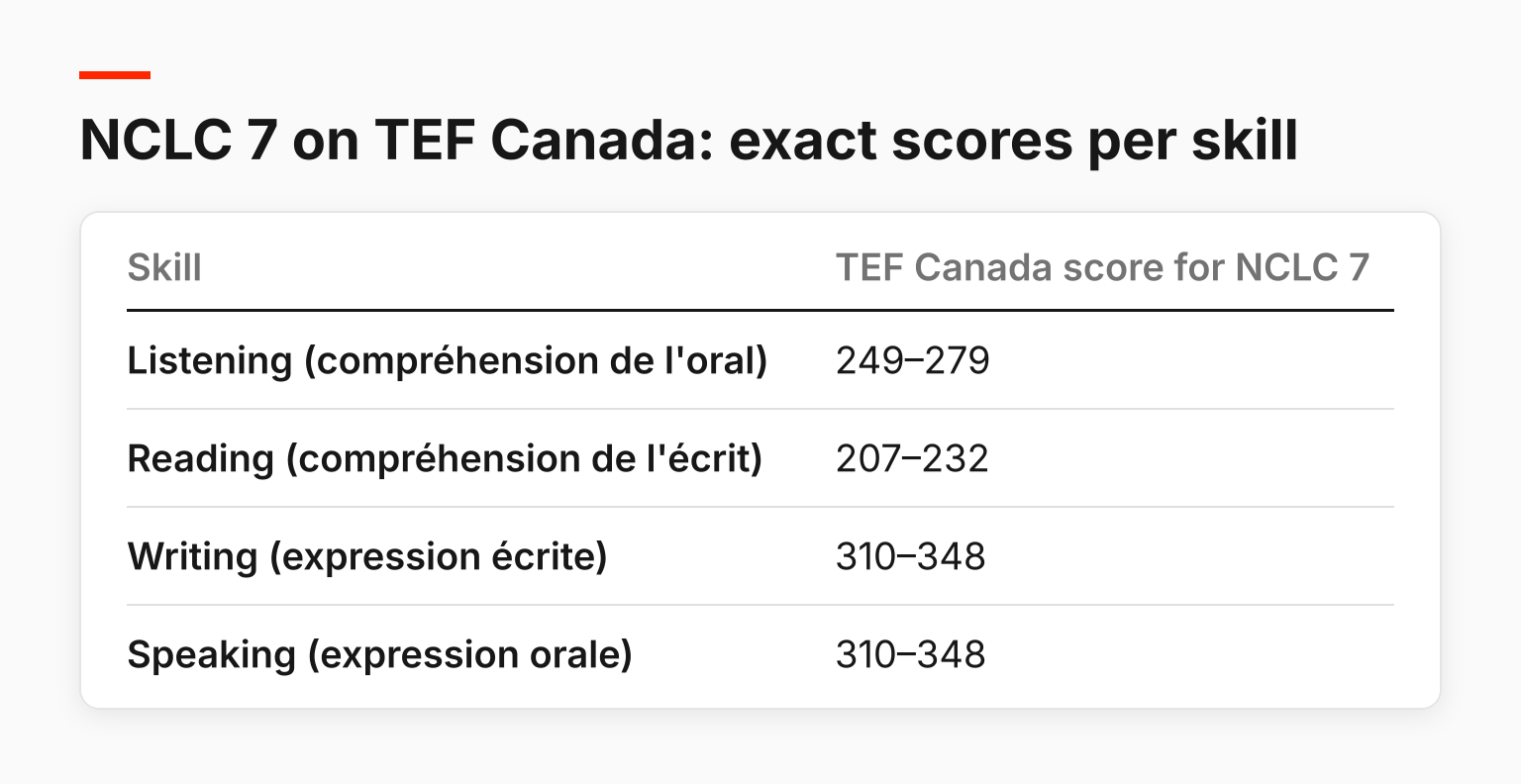
| Skill | TEF Canada score for NCLC 7 |
|---|---|
| Listening (compréhension de l'oral) | 249–279 |
| Reading (compréhension de l'écrit) | 207–232 |
| Writing (expression écrite) | 310–348 |
| Speaking (expression orale) | 310–348 |
One warning that catches many candidates: when you enter TEF Canada results into your Express Entry profile, use the "Équivalence ancien score" column on your certificate. Do not use the "Score / 699" column. IRCC states plainly that entering the wrong scores can lead to refusal. Scores above these ranges put you at NCLC 8 or higher, which earns more points.
For the full conversion chart across levels, see the site's guide to TEF & TCF Canada to NCLC conversion: NCLC 7 scores.
NCLC 7 on TCF Canada: exact scores per skill
The TCF Canada uses different score ranges, so the target looks different even though the NCLC level is the same:
| Skill | TCF Canada score for NCLC 7 |
|---|---|
| Listening (compréhension de l'oral) | 458–502 |
| Reading (compréhension de l'écrit) | 453–498 |
| Writing (expression écrite) | 10–11 out of 20 |
| Speaking (expression orale) | 10–11 out of 20 |
All four ranges come from IRCC's official language test page for Express Entry. These figures are checked against IRCC as of 2026, but the agency can update its grids, so confirm the current chart on canada.ca before you book a test.
Choosing between the two tests matters here, because the same NCLC level demands different point totals. If you have not picked a test yet, read the site's comparison of TEF Canada vs TCF Canada.
Each skill counts separately
This is the rule that surprises people most: IRCC converts each ability on its own. There is no averaging across skills.
Say you score at NCLC 7 or higher in three skills and NCLC 6 in listening. For any requirement that asks for NCLC 7, you do not meet it. The same holds for the French CRS bonus: IRCC awards the 25 or 50 extra points only when you score NCLC 7 or higher in all four French skills. One skill at NCLC 6 moves you out of the bonus entirely.
This is why balanced preparation beats focusing on your strong skills. Your weakest skill sets your level.
Where NCLC 7 is required in Express Entry
Whether NCLC 7 is your target depends on which program you apply under. Here are the French language minimums from IRCC, verified against canada.ca as of 2026:
| Program | French minimum |
|---|---|
| Federal Skilled Worker (first official language) | NCLC 7 in all four skills |
| Federal Skilled Worker (second official language) | NCLC 5 |
| Canadian Experience Class, TEER 0 or 1 jobs | NCLC 7 in all four skills |
| Canadian Experience Class, TEER 2 or 3 jobs | NCLC 5 in all four skills |
| Federal Skilled Trades | NCLC 5 in speaking and listening, NCLC 4 in reading and writing |
So NCLC 7 is the hard requirement for Federal Skilled Worker applicants using French as their first official language, and for CEC applicants in TEER 0 or 1 occupations. For CEC in TEER 2 or 3, and for Federal Skilled Trades, lower levels are enough for eligibility.
What NCLC 7 unlocks beyond basic eligibility
Even where a lower level would make you eligible, NCLC 7 opens two big doors.
First, the French CRS bonus. IRCC awards extra Comprehensive Ranking System points when you score NCLC 7 or higher in all four French skills: 25 points if you scored CLB 4 or lower in English (or never took an English test), and 50 points if you scored CLB 5 or higher on all four English skills. This is confirmed on IRCC's CRS criteria page. On top of that, French as a second official language earns its own regular CRS points once you clear NCLC 5.
Second, French-language category draws. IRCC runs category-based Express Entry rounds, and French language proficiency is one of those categories. The French category requires NCLC 7 in all four abilities. Candidates invited through these draws typically face much lower CRS cutoffs than general draws.
Want to see what French is worth in your own profile? The site's free tool at How Much Does French Boost Your CRS Score? estimates your French CRS boost.
How old your test results can be
Language test results expire. IRCC requires your results to be less than two years old at the time you submit your Express Entry profile and again when you apply for permanent residence. If your results are about to hit the two-year mark, plan for a retake before either deadline. Timing this badly has cost people their invitations.
What to do if you are below NCLC 7
Most candidates reading this page are somewhere around A2 or B1 on the CEFR scale, which maps below NCLC 7. The gap is real but closable with focused work, usually by drilling your weakest of the four skills first and practicing with exam-format tasks rather than general study alone.
A practical starting point: the site's guide How to Get NCLC 7 in TEF Canada lays out a study plan for exactly this gap. And once you know your target level, the free NCLC 7+ time estimator helps you estimate how many months of preparation you realistically need.
Next step: pick your test and start targeting scores
You now know what NCLC 7 means, the exact scores it takes on both tests, and where the threshold applies. The remaining decisions are which test to take and how long you need to prepare.
If you want structured practice toward NCLC 7+, CanadaFrenchPath offers four-skill practice with mock exams, AI grading, and NCLC tracking so you can see exactly when each skill crosses the threshold. You can sign up to start free practice with 1,000 credits and test the method before committing to anything.