
TL;DR
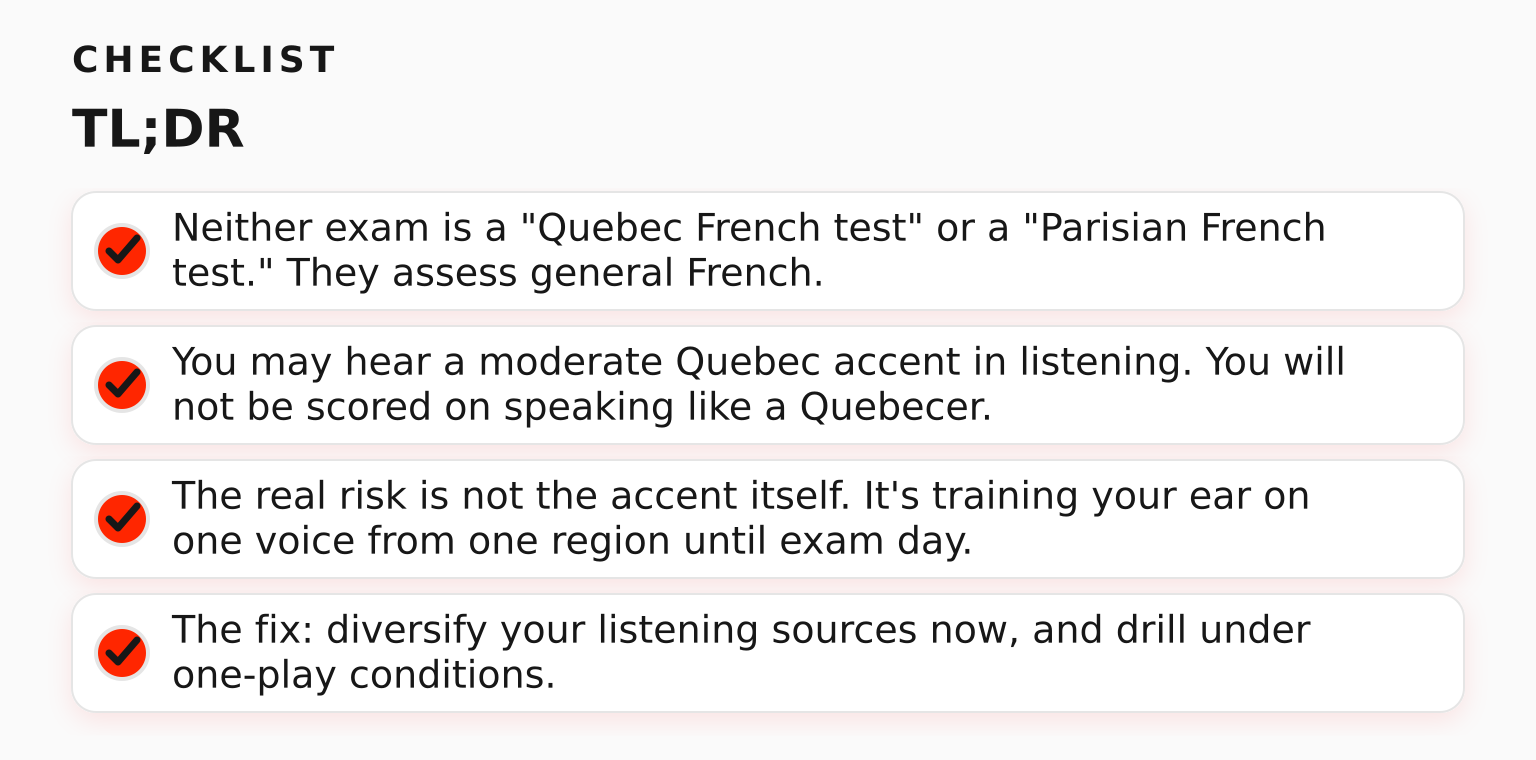
- Neither exam is a "Quebec French test" or a "Parisian French test." They assess general French.
- You may hear a moderate Quebec accent in listening. You will not be scored on speaking like a Quebecer.
- The real risk is not the accent itself. It's training your ear on one voice from one region until exam day.
- The fix: diversify your listening sources now, and drill under one-play conditions.
If you're moving to Quebec, this matters twice: once for the exam, and again for everyday life after you land.
The short answer: it's both, and the examiners don't publish the mix
A common worry among candidates headed to Canada: "Will I hear Parisian French or Quebecois French on the listening section?" The honest answer is that both exams assess general French, but the audio is not frozen to one accent.
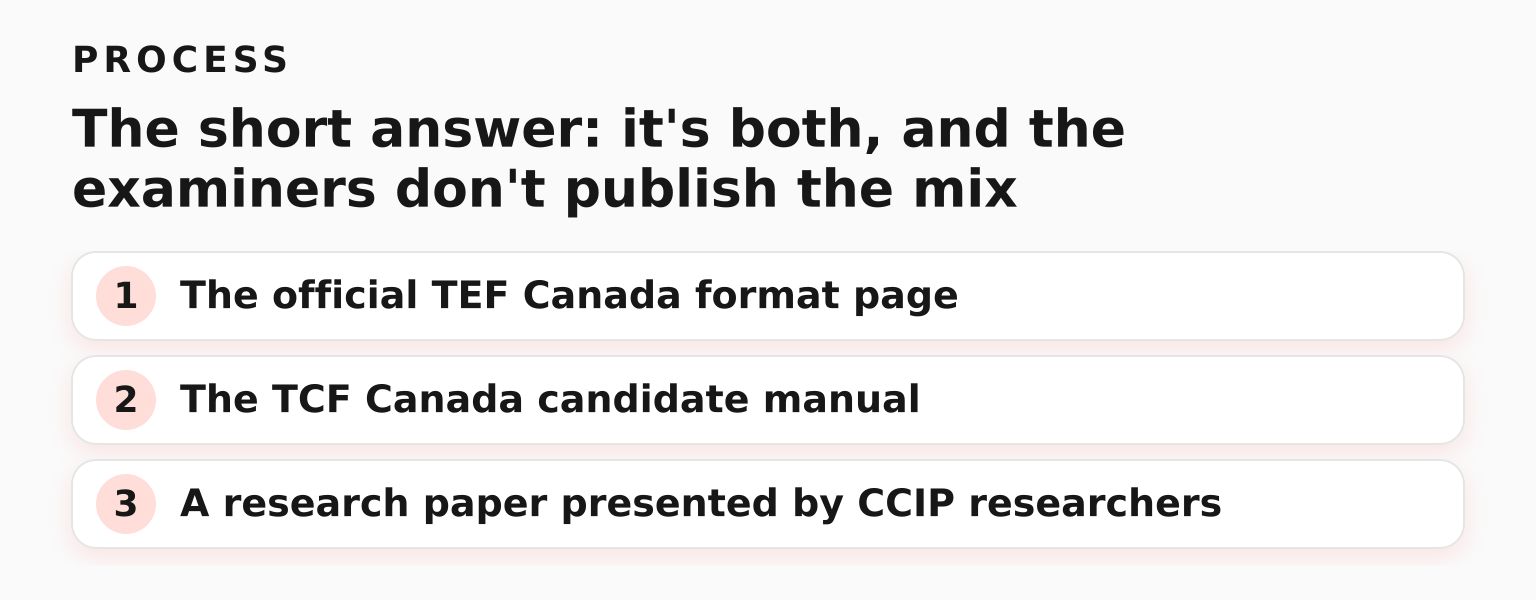
Three pieces of evidence back that up:
- The official TEF Canada format page describes listening as measuring "your ability to understand spoken French" across everyday situations, with no accent specification. That is standard for both exams: they test French as it is spoken internationally.
- The TCF Canada candidate manual is more explicit. It notes that some listening comprehension items "mark a belonging to the Canadian francophone universe by their accent and/or the context of the situation."
- A research paper presented by CCIP researchers (Casanova, Aw, Bourras, and Demeuse, ADMEE 2018) found that recent TEF listening forms included moderately Quebec-accented items, and that accent had only a limited effect on comprehension differences between candidates in Canada and candidates in France.
What nobody publishes is a percentage. Neither exam body posts an official breakdown of how many items use which accent. Prep sites claim everything from "you'll never hear Quebec French" to "half the test is Quebecois." Treat both extremes as speculation. Candidate anecdotes about one test sitting tell you about one test sitting.
What the listening sections actually look like
Knowing the format sharpens why accent matters at all:
| TEF Canada | TCF Canada | |
|---|---|---|
| Questions | 40 multiple choice | 39 multiple choice |
| Duration | 40 minutes | 35 minutes |
| Audio plays | Once, no replay | Once, no replay |
| Difficulty | Mixed everyday situations | Progressive: starts easy, gets harder |
| Answering | As you go; you can't go back | Question comes after each audio |
The details come from the official TEF Canada examination page and the Université de Sherbrooke's TCF Canada listening description.
Two format facts should shape your preparation more than any accent question. First, each recording plays once. If an accent costs you two seconds of processing time, that's two seconds you never get back. Second, on the TEF you answer as you go and can't return, so a miss on one confusing voice cascades. For a deeper dive on the second exam, see our TCF Canada Guide (2026): Format, Scores & Immigration.
What actually makes Quebecois French harder to hear
Quebecois and Parisian French are the same language. But Quebec speech has a few sound features that can trip a France-trained ear. Recognizing them in advance is most of the battle:
- Affrication of t and d. Before certain vowels, "t" can sound like "ts" and "d" like "dz." So "tu" can land closer to "tsu," and "dans le fond" can sound like "dzans le fond." This is the single most noticeable feature for new listeners.
- Shifted vowels. A stressed "a" can drift toward a different vowel color, and some vowels in word endings shorten or drop in fast speech. Words you know on paper can sound unfamiliar aloud.
- Faster speech rate. Quebec conversational French runs quickly, especially in informal contexts. Radio broadcasters are the calibrated middle ground.
- Contractions. Everyday Quebec speech compresses small words aggressively. "Tu es" becomes "t'es" and then vanishes further, and prepositions fuse in ways textbooks rarely show.
None of this means learning a new language. It means retraining your ear on sounds you already know, pronounced differently.
One more calibration note: the realistic target is standard Quebec French, the register you hear on Radio-Canada news. Street-level slang (sometimes called joual) is not what exam audio uses, and chasing it wastes study time.
Quebecois vs Parisian French, side by side
| Feature | Parisian / standard French | Quebecois French |
|---|---|---|
| t and d | Plain "t" and "d" sounds | Often affricated before front vowels: "tu" ≈ "tsu" |
| Vowels | The reference set most textbooks teach | Shifted colors; endings can shorten or drop in fast speech |
| Speech rate | Slower, more even in media | Noticeably faster in casual speech |
| Small-word contractions | Present but milder | Heavy: "t'es," fused prepositions |
| Vocabulary | Standard international French | Some distinct everyday words and expressions |
| Register on broadcast media | Anchors speak textbook-clear French | Radio-Canada anchors speak clear standard Quebec French |
This table is about listening comprehension, not speaking. It should not change how you produce French. Which brings up an important boundary.
What accent does not change
Your speaking and writing sections reward clear, standard French. Period. Quebec expressions will not earn you points, and neither will imitating a Parisian accent. The graders assess your level against the NCLC scale, not your regional flavor. Write "je suis" and speak clearly; that is the standard on every section.
How to train your ear for both accents
Prepare for variety, not for one accent. A single-voice listening diet is the real danger: candidates who study exclusively with one app's synthetic voice or one podcast series often get shocked when exam audio shifts speed and texture.
A workable weekly routine:
- Rotate your sources. Mix France-based media (TV5Monde, France Inter) with Quebec-based media (Radio-Canada ICI programs, Quebec-made podcasts). Alternate by day, not by month, so both stay warm.
- Do short dictation passes. Take one minute of audio, transcribe what you hear, then check against reality. This exposes exactly which sounds you mishear, including affrication.
- Shadow Quebec audio. Pause a Radio-Canada clip and repeat it aloud. Speaking the sounds helps you recognize them faster later.
- Drill under exam conditions. Once a week, do a full listening section where each audio plays once and you answer before moving on. Numbers are a classic one-play trap under accent stress, so if you haven't yet, work through French Numbers for TEF Canada Listening: Dates, Prices & Phone Numbers.
If you want free graded listening material, TV5Monde's apprendre platform sorts clips by level and comes with transcripts, which makes it a good dictation source. France-based audio is only half the job; keep Quebec voices in the mix.
Mock exams and section drills that reproduce the one-play condition are one way to build this habit. If you want structured practice, you can start free practice with 1,000 credits on CanadaFrenchPath, with exam-style listening, mock exams, and NCLC tracking.
Still deciding between the two exams? Our TEF Canada vs TCF Canada comparison covers format, scoring, and which fits your immigration file.
Why this matters after test day, especially in Quebec
If your destination is Quebec, the listening exam is a warm-up. Government offices, landlords, coworkers, and the pharmacy will all speak to you in Quebec French, often faster than exam audio. The ear you build for the exam is the same ear you'll need at the dépanneur. Training for accent variety now is studying for two goals at once, and that makes it some of the highest-return work in your prep plan.