
TL;DR
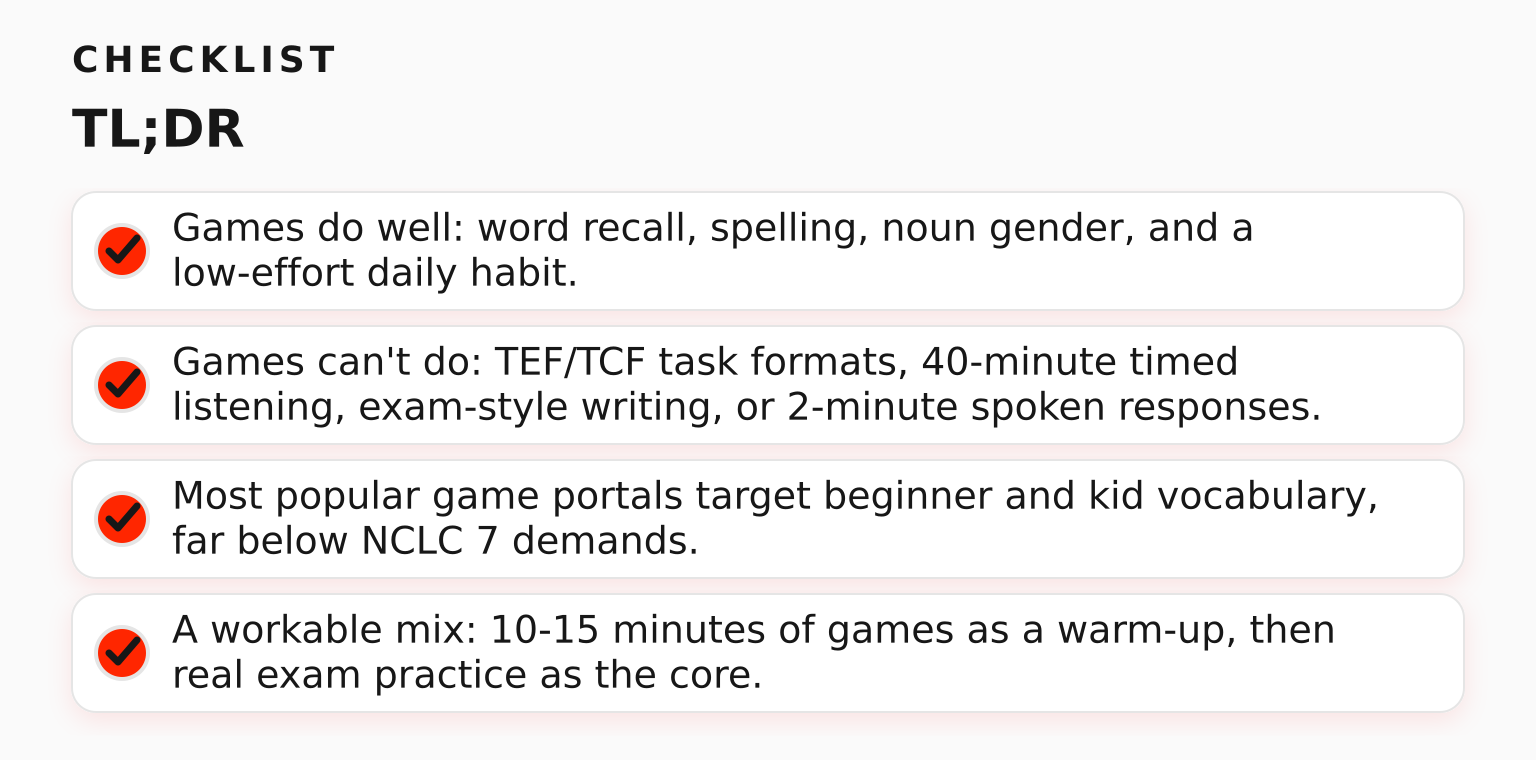
- Games do well: word recall, spelling, noun gender, and a low-effort daily habit.
- Games can't do: TEF/TCF task formats, 40-minute timed listening, exam-style writing, or 2-minute spoken responses.
- Most popular game portals target beginner and kid vocabulary, far below NCLC 7 demands.
- A workable mix: 10-15 minutes of games as a warm-up, then real exam practice as the core.
The short answer: can games alone get you to NCLC 7?
No. If your goal is NCLC 7+ on TEF Canada or TCF Canada for immigration, french games for learning french will not get you there on their own. They build vocabulary recognition and make practice easier to start. That matters. But the exam tests four skills under time pressure, in specific formats, and no word game or matching quiz trains those formats.
Think of it this way: a game can teach you that "embaucher" means to hire. The exam asks you to write a formal email arguing a point, or speak for two minutes on a familiar topic, or follow a fast dialogue between two people. Those are production and comprehension tasks, and they need different practice.
That said, dismissing games entirely would be a mistake. Used in the right slot of your week, they earn their place. Used as your main study method, they produce a familiar result: you feel busy, your game scores rise, and your mock exam score doesn't. If that sounds like where you are, it's worth reading why most TEF Canada candidates plateau and how to break through.
What French games are genuinely good for
Games do four things well, and all four matter to an exam candidate:
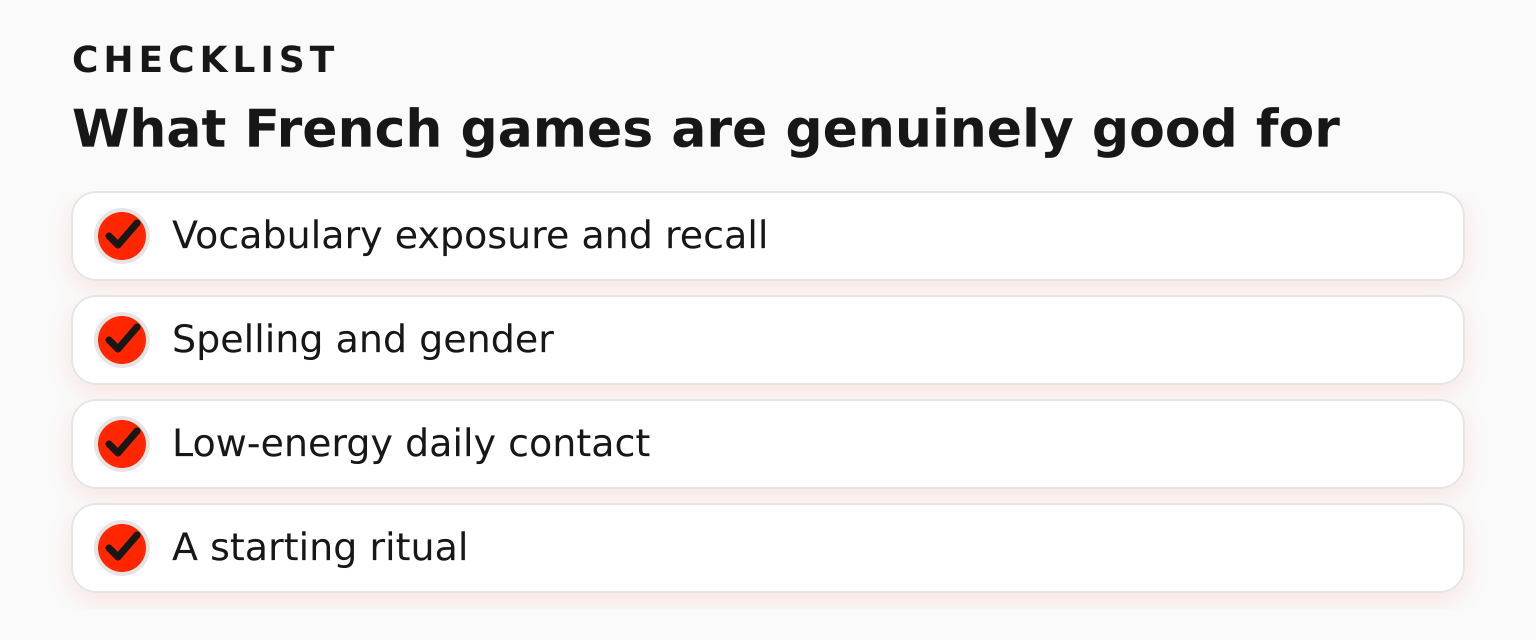
- Vocabulary exposure and recall. Repetition under light pressure helps words stick. Word games like matching, memory, and hangman-style spelling drills push you to retrieve a word, not just recognize it. Retrieval is what you need on exam day.
- Spelling and gender. French spelling is unforgiving, and noun gender (le/la) affects agreement in writing. Spelling games and quizzes give cheap, fast reps on exactly this. Some word lists even flag gender with every word; the word-builder games on Digital Dialects' intermediate and advanced page mark each noun as masculine or feminine, for example.
- Low-energy daily contact. Some days you have 45 minutes of focus; some days you have 10 minutes on the bus. A game session keeps French in your head on the low days, so you never fully break the habit.
- A starting ritual. Ten minutes of a word game before a study session is a surprisingly good warm-up. It switches your brain into French before the harder work begins.
Adult learners play these games too. Threads like this Online French word games discussion on r/French collect the word games people actually use, and most of what gets shared is vocabulary practice, not exam training.
What games cannot train
Here's the honest part. The skills that decide your NCLC 7 result are mostly invisible to games:
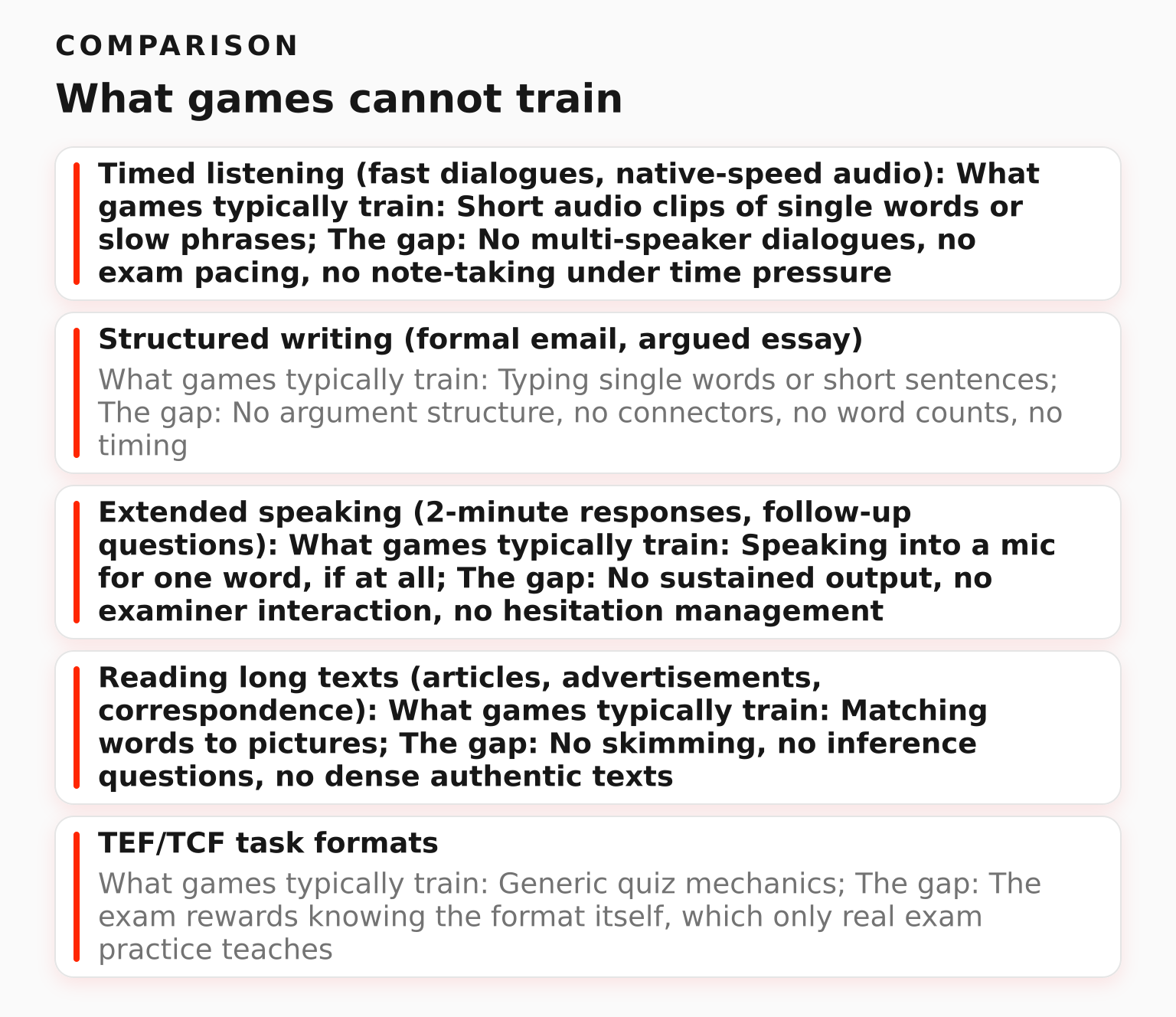
| Skill the exam tests | What games typically train | The gap |
|---|---|---|
| Timed listening (fast dialogues, native-speed audio) | Short audio clips of single words or slow phrases | No multi-speaker dialogues, no exam pacing, no note-taking under time pressure |
| Structured writing (formal email, argued essay) | Typing single words or short sentences | No argument structure, no connectors, no word counts, no timing |
| Extended speaking (2-minute responses, follow-up questions) | Speaking into a mic for one word, if at all | No sustained output, no examiner interaction, no hesitation management |
| Reading long texts (articles, advertisements, correspondence) | Matching words to pictures | No skimming, no inference questions, no dense authentic texts |
| TEF/TCF task formats | Generic quiz mechanics | The exam rewards knowing the format itself, which only real exam practice teaches |
None of this means games are bad. It means games sit in the warm-up and reinforcement slot, not the core.
Which kinds of games fit which need
Not all games do the same job, so match the type to what you're missing:
- Word games (crosswords, hangman, memory match, scrabble-style play) are best for vocabulary recall and spelling. Use them on topics you're already studying, so the game reinforces words you met in context.
- Grammar and verb games are best for conjugation and sentence patterns. A site like French Grammar Games drills things like negations, relative pronouns, and verb tenses, which feeds directly into your writing accuracy. KwizIQ's game library takes the same approach with word-association and synonym games.
- App-style vocabulary games (Duolingo-style lessons, picture matching) give light daily contact with the language. They're the weakest fit for exam prep, but fine as a streak-keeper on low-energy days.
The dividing line is simple: games work as warm-ups and reinforcement. They fail as your core method, because the core is producing and understanding French under time pressure.
The trap: most "French games" are built for beginners and kids
Search for French games and you'll land on portals full of bright, simple activities. They're good at what they do, but look at what they do. french-games.net describes itself as a resource for beginners, with over 100 topics aimed at kids, parents of kids, and young adults. Its beginner lessons introduce just 10 words each, and its own FAQ says the French provided is beginner level. Digital Dialects puts most of its catalog on a beginner page and keeps a much smaller set of word-builder games on its separate intermediate and advanced page.
Meanwhile, NCLC 7 is the minimum Express Entry requires in all four abilities, and it sits in the B2 band on the CEFR equivalency table used for TEF Canada scores. You can check the score bands on the Government of Canada's language test page and the NCLC-to-CEFR equivalency table. B2 means several thousand words used in context, complex sentence structures, and comfort with authentic native-speed material. A game that celebrates you for matching ten animal words is not measuring anything the exam cares about. It's not wasted time, but it is not exam prep, and confusing the two is how months disappear.
How to learn French words quickly (and make game time actually count)
If vocabulary is your weak point, the fastest route is not more games. It's learning words in phrases with spaced repetition, then using games to reinforce what you already studied.
- Learn chunks, not single words: "prendre une décision", "il s'agit de", "du coup". Phrases give you grammar for free and show up directly in writing and speaking. I've written more about this in How I Improved My French Vocabulary Faster by Stopping Word Lists.
- Review on a spaced schedule: revisit a word a day later, then three days, then a week. Spaced repetition is what moves vocabulary into long-term memory.
- Then use games as the reinforcement layer. A 10-minute game on food vocabulary the day after you studied food phrases is effective. A 10-minute game as your only vocabulary method is not.
A weekly routine where games earn their place
Here's a simple structure for someone targeting NCLC 7, assuming you study 5 to 8 hours a week:
- Daily warm-up (10-15 min). A word or grammar game, ideally on vocabulary you studied this week. This is your low-energy day slot too.
- Two skill drills per week (2 x 45 min). Rotate listening, reading, writing, and speaking so all four get touched. Target your weakest skill first.
- One mock exam or timed section per week (60-90 min). Under real timing. This is the single highest-value session in your week, because it trains format, pacing, and stamina at once. If you're choosing between options, this guide to finding the best TEF Canada practice exams, free and paid, covers what to look for.
- One feedback session (30 min). Review your writing or speaking with feedback, note recurring errors, and turn them into next week's drills.
- Friday reward (optional). An extra game session, guilt-free, as long as items 2 through 4 happened.
That puts games at roughly 10-15% of your week, which is about right. If you're not sure how much time you actually have before your test date, the NCLC 7+ time estimator helps you work backwards from your target and plan the mix accordingly.
This routine is a compressed version of the structured approach in How to Get NCLC 7 in TEF Canada (Even if You're Currently A2 or B1), which lays out the full study plan.
Signs your game time is working (and signs it isn't)
The test is transfer. Games are helping if:
- Words you drilled in games start showing up when you read articles or hear dialogues.
- You can use game-learned vocabulary in a sentence you wrote yourself, not just match it to a picture.
- Your spelling errors on written practice drop over a month.
Games are eating your prep time if:
- Your game streak is long but your last mock exam score didn't move.
- You know hundreds of isolated words but stall when asked to write a full paragraph.
- Game sessions are quietly replacing listening and speaking practice, week after week.
Common questions
What is the best way to practice French for an exam like TEF Canada? Practice the exam itself, in the exam's format and timing. Mock exams and timed section drills build the skills the score measures. Add reading and listening with authentic material, phrase-based vocabulary study, and a small game warm-up if it helps you start consistently.
Do Duolingo-style apps count as real study? They count as light contact. App-style games teach recognition of words and simple sentences, which is a real but early-stage skill. For NCLC 7, treat them as a supplement to writing, speaking, and timed listening practice, never as the main method.
How much game time is reasonable per week? Around 30 to 60 minutes total, spread into 10-15 minute sessions, is plenty. If game time grows past that while mock exam scores stay flat, rebalance toward drills and mocks.
Which games are worth an adult exam candidate's time? Grammar and verb conjugation games, spelling games, and vocabulary games on topics you're actively studying. Skip kid-oriented picture-matching games unless you're starting from zero.
Next step
If you've recognized that games are the warm-up, not the workout, the missing layer is structured practice: mock exams, section drills across all four skills, and feedback that tells you exactly where you stand against NCLC 7. That's what CanadaFrenchPath is built for. You can sign up to start free practice with 1,000 credits today.